
How Electronic Gases contamination shows up in yield
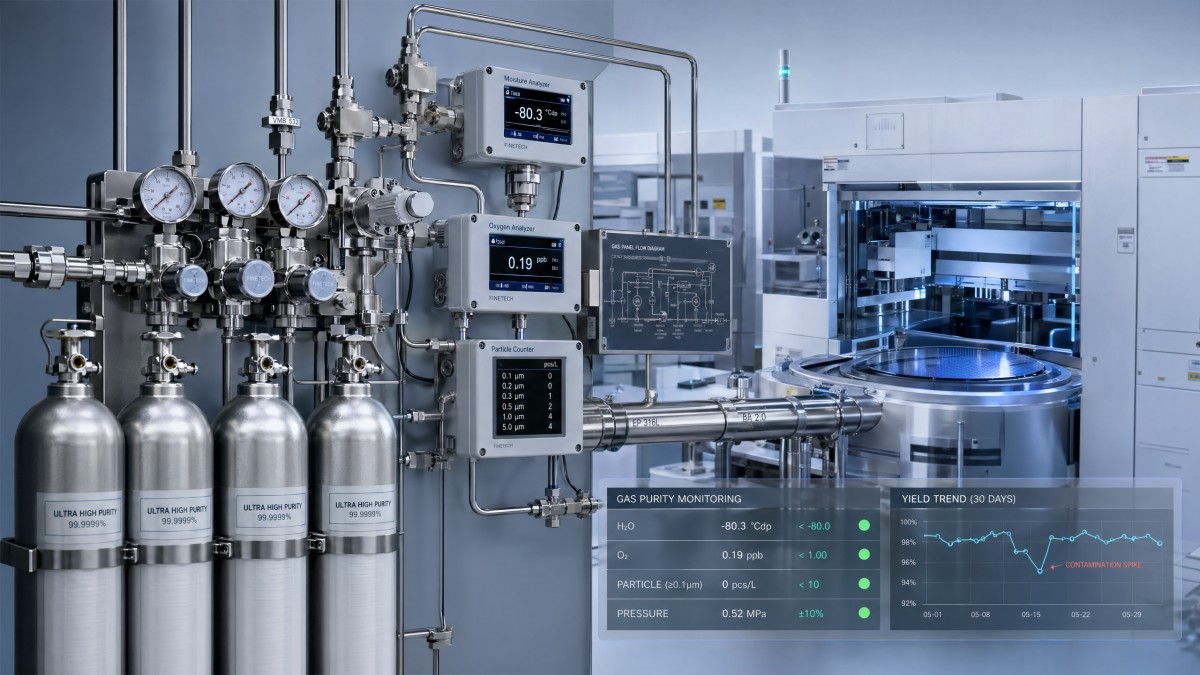
In advanced manufacturing, Electronic Gases contamination rarely announces itself directly—it appears first as unexplained yield loss, drifting process stability, and latent quality risks. For quality control and safety managers, recognizing these early signals is essential to preventing costly defects, compliance issues, and production disruption. Understanding how contamination propagates through gas delivery and process environments is the first step toward tighter control and more reliable output.
Why does Electronic Gases contamination show up in yield before anyone sees it in the gas line?
For most fabs, precision coating lines, and high-purity process environments, contamination in Electronic Gases does not begin as a dramatic alarm event. It starts as a small shift in deposition rate, a wider etch profile distribution, more particles on critical surfaces, or a gradual increase in scrap over 1 to 3 production lots. Because the gas may still meet a basic incoming specification, the first visible symptom is often reduced yield rather than an obvious utility failure.
This happens because ultra-high purity gas systems operate in narrow process windows. A contaminant level in the low ppm or even ppb range can change reaction chemistry, chamber wall conditions, or moisture loading enough to affect defectivity. In ALD, CVD, etch, annealing, and specialty atmosphere applications, a variation of only a few seconds in purge performance or a slight rise in oxygen or water can alter film quality, adhesion, resist behavior, or electrical characteristics.
For quality control teams, the key lesson is simple: yield loss is often an indirect contamination indicator. For safety managers, the same contamination event can also point to valve degradation, poor cylinder change procedures, dead legs in gas lines, or backflow risks. In other words, process quality and gas safety integrity are often linked through the same root cause chain.
What kinds of contamination are most common?
The most common categories are moisture, oxygen, hydrocarbons, particles, metallic residues, and cross-contamination from previous gases or cleaning agents. In specialty gases, even trace contamination introduced during cylinder changeover, manifold maintenance, or regulator replacement can affect downstream performance. The risk increases in systems with frequent changeouts, long distribution lines, or mixed-use gas cabinets.
- Moisture can affect film uniformity, oxidation behavior, and corrosive byproduct formation.
- Oxygen can change plasma chemistry, deposition selectivity, and electrical properties.
- Particles can seed defects, block small orifices, and cause wafer or component rejection.
- Hydrocarbons may interfere with high-purity surface reactions and critical cleaning steps.
- Residual process gas can create false process signatures after maintenance or gas switching.
In practical terms, contamination rarely stays in one category. A leaking seal may bring in moisture and oxygen together. A damaged regulator seat may generate both particles and flow instability. That is why yield analysis should never be separated from gas path integrity review.
What is the earliest operational clue?
One of the earliest clues is a drift that remains below alarm thresholds but exceeds normal process control expectations. Examples include a 2% to 5% shift in deposition thickness, a higher frequency of rework within 24 to 72 hours, or chamber seasoning that becomes less repeatable after every cylinder replacement. If the issue appears sporadically across tools sharing one gas family, Electronic Gases contamination should move high on the investigation list.
How can quality control and safety managers tell whether yield loss is really linked to Electronic Gases?
The strongest indicator is correlation across time, tool condition, and gas handling events. If yield drops consistently follow cylinder changes, preventive maintenance, startup after shutdown, or line purging, the gas system deserves close scrutiny. Quality teams should compare lot history, SPC drift, defect maps, and chamber qualification records over at least 2 to 4 weeks rather than judging one failed batch in isolation.
Safety managers should review gas cabinet logs, purge sequences, valve cycle counts, leak checks, and changeout discipline. Many contamination problems are not caused by the gas source itself but by interfaces: seals, welds, fittings, diaphragm wear, pressure transients, or incomplete inert purging. A system can pass a basic leak test and still allow contamination through poor procedural control.
The following table helps separate likely gas-related symptoms from other common yield-loss causes. It is especially useful in cross-functional reviews involving process engineering, facilities, EHS, and supplier quality.
This comparison does not prove the root cause by itself, but it helps narrow investigation scope faster. In many facilities, the difference between a one-shift disturbance and a week-long yield excursion is whether gas-related clues are identified early.
Which records are worth reviewing first?
Start with five records: incoming gas documentation, cylinder lot traceability, gas cabinet maintenance logs, tool-level SPC trends, and incident timing around changeouts or shutdowns. If three or more of these records point to the same 48-hour window, there is enough evidence to escalate a focused contamination review without waiting for a larger yield event.
What are the most common contamination pathways in Electronic Gases systems?
Contamination usually enters through interfaces, transitions, and undercontrolled procedures. Even when source gas quality is strong, impurities may be introduced at the cylinder valve, regulator, manifold, VCR fitting, purge panel, or point-of-use connection. Systems serving semiconductor, display, optical coating, and advanced materials applications often have enough complexity that a single weak component can affect multiple process tools.
Another common pathway is insufficient purge discipline. A purge recipe that looks adequate on paper may be too short for line volume, dead space, or the previous gas used. In practice, 3 cycles may be enough for one line design but insufficient for another. The correct purge approach depends on pressure, flow path geometry, gas chemistry, and the acceptable contamination threshold for the process.
Back diffusion, material incompatibility, and maintenance contamination are also frequent contributors. Elastomer exposure, poorly cleaned replacement parts, and ambient air ingress during intervention can all introduce instability. For safety managers, this matters because the same weaknesses that degrade purity can also raise exposure, corrosion, or reactivity risks.
Which components deserve the closest attention?
The highest-risk points are usually not the largest components, but the most frequently handled ones. Changeover interfaces, regulators, valves, filters, and point-of-use connections often deserve higher monitoring frequency than long static pipe runs.
- Check cylinder connection practices after every changeout and verify purge completion.
- Review regulator service life after defined cycle ranges, such as every 6 to 12 months in intensive use.
- Inspect filters and point-of-use hardware when particle counts or pressure drop trends change.
- Validate maintenance cleanliness before returning lines to production service.
- Compare gas path materials with actual gas chemistry, especially in corrosive or reactive service.
How do contamination pathways differ by process type?
In deposition processes, trace moisture or oxygen may first appear as thickness non-uniformity or unexpected film stress. In etch systems, contamination may show up as profile drift or lower selectivity. In inert atmosphere packaging or advanced welding environments, the same issue may present as surface discoloration, bonding inconsistency, or reduced joint quality. The visible defect changes by application, but the contamination logic remains consistent.
What should teams measure, compare, and document when investigating Electronic Gases contamination?
A useful investigation combines process evidence with gas system evidence. Quality teams should document lot IDs, tool IDs, defect categories, and the timing of process drift. Safety and facilities teams should add gas source lot number, cabinet ID, pressure behavior, purge sequence, alarm history, and intervention records. This dual-track method reduces the chance of blaming chambers alone when the real trigger is upstream contamination.
The most informative comparison is often before-versus-after at a defined event boundary: cylinder replacement, maintenance restart, or tool return to service. If defect rates move from a stable baseline to a materially higher level within 1 or 2 lots, and no recipe or hardware changes occurred, Electronic Gases should be treated as a plausible root cause until disproved.
The table below provides a practical checklist for investigation and escalation. It is designed for quality control and safety managers who need a repeatable framework rather than a one-time troubleshooting reaction.
A structured checklist also improves supplier discussions. Instead of asking whether the gas was “good or bad,” teams can ask whether delivery stability, impurity trends, packaging integrity, and handling controls matched the actual process sensitivity of the line.
Which standards and practices support better control?
Teams typically benefit from aligning their review process with common semiconductor and high-purity handling practices, including relevant ISO documentation discipline, SEMI-oriented purity handling logic, and internal change control procedures. The exact standard set depends on the plant, but the operational principle is consistent: define baseline purity, define handling discipline, define escalation thresholds, and document every intervention that could affect gas integrity.
What are the most common mistakes when responding to Electronic Gases contamination?
A common mistake is treating contamination as only a supplier issue. In reality, many failures occur after delivery, inside the user’s own distribution system. If incoming certification is reviewed but gas cabinet condition, purge validation, and maintenance cleanliness are ignored, the investigation remains incomplete. This often leads to repeated yield loss because the local contamination pathway was never corrected.
Another mistake is over-focusing on one dramatic event instead of trend behavior. Electronic Gases contamination often behaves like a pattern problem. Small abnormalities appearing every 2 or 3 weeks may reveal more than one major excursion. Quality managers should pay attention to recurring micro-signals such as longer chamber stabilization, higher first-lot variability, or more frequent hold decisions after startup.
A third mistake is separating quality and safety ownership too sharply. The same incident may involve contamination, leak risk, corrosive byproduct formation, and operator handling exposure. When quality, EHS, facilities, and production engineering review these events together, root cause closure is usually faster and preventive controls are stronger.
What does a better response look like?
A better response is disciplined, comparative, and preventive. Teams should quarantine suspect variables, compare affected and unaffected tools, validate purge performance, inspect high-touch hardware, and review recent interventions. If needed, they should also tighten acceptance criteria for especially sensitive process steps rather than relying on broad utility-level assumptions.
- Define a rapid-response review window such as 24 hours for major yield drift and 72 hours for moderate recurring anomalies.
- Keep shared traceability between lot data, gas source data, and maintenance actions.
- Use post-maintenance requalification that includes gas integrity checks, not just tool function checks.
- Train operators on contamination-sensitive changeouts, not only on safety compliance steps.
If a company wants better prevention, what should it confirm before sourcing, upgrading, or auditing a gas system?
Before making sourcing or system decisions, companies should confirm the actual process sensitivity of each gas application. Not every line needs the same level of purity assurance, but advanced deposition, etch, implant support, precision coating, and analytical environments often require tighter controls than general utility thinking would suggest. A mismatch between process sensitivity and gas handling design is one of the most expensive hidden risks in modern manufacturing.
They should also clarify where responsibility begins and ends: source gas quality, packaging condition, storage, internal distribution, point-of-use filtration, and operator procedure. A useful audit asks not only what impurity level is allowed, but where that impurity can be introduced during the full delivery path from cylinder receipt to process chamber entry.
For procurement, quality control, and safety teams, a practical review framework usually includes technical specifications, service intervals, compatibility, traceability, and turnaround expectations. Delivery lead times may range from several days for standard supply arrangements to several weeks for specialized configurations, so contamination control planning should be integrated with purchasing timelines rather than left to emergency response.
Which pre-purchase or pre-audit questions matter most?
The most effective questions are the ones that reduce ambiguity before a problem occurs. These questions should be asked internally and externally, especially when evaluating Electronic Gases supply strategy or high-purity gas infrastructure upgrades.
- What impurity ranges are acceptable at the point of use, not only at shipment?
- Which components have the highest contamination risk under actual cycle frequency?
- What purge sequence is validated for this gas family and line geometry?
- How are cylinder lots, maintenance actions, and yield events linked in traceability records?
- What is the expected service interval for regulators, valves, and filters under current usage?
- What documentation is available for compatibility, handling guidance, and change control?
Why choose us for technical evaluation and sourcing discussions?
At G-UPE, we support buyers and technical decision-makers who need more than a broad product description. Our focus is the engineering reality behind Electronic Gases performance: purity risk pathways, delivery system sensitivity, process-window implications, and benchmarking logic across high-precision industries. This is especially valuable for quality control and safety managers who must balance yield protection, operating discipline, and compliance expectations.
If you are evaluating gas purity requirements, comparing delivery configurations, reviewing contamination risk, or aligning procurement with technical acceptance criteria, we can help structure the discussion around what matters most. That may include parameter confirmation, product and component selection, lead-time expectations, handling strategy, certification requirements, sample support possibilities, and quotation communication for specialized applications.
Contact us if you need a clearer basis for judging Electronic Gases contamination risk in your process environment. A productive first conversation usually starts with five points: your gas type, application step, current symptom pattern, delivery architecture, and required control threshold. From there, it becomes easier to identify whether you need tighter specifications, a handling upgrade, a supplier comparison, or a more targeted corrective action plan.
Taglist:
Recent Articles
 2026.10.14How air pressure affects precision pneumatic actuator repeatabilityPrecision Pneumatic actuator repeatability depends on more than supply pressure. Discover how pressure, friction, and flow affect positioning—and how to improve consistency in your application.
 2026.10.13How to choose a packaging manufacturer for small production runsChoose a packaging manufacturer for small production runs with confidence. Discover how to compare costs, verify samples, and secure quality packaging without excess inventory.
 2026.10.12Ultra-Pure Chemicals in Latin America: What Shapes Regional Supply and Demand?Ultra-pure chemicals Latin America: explore demand drivers, qualified supply, and purity risks to uncover smarter sourcing and investment opportunities.
 2026.10.12How Much Does an Optical Tweezers System Cost?Explore optical tweezers system price ranges, key cost drivers, and ownership expenses. Compare configurations and learn how to choose the right setup for your research budget.
 2026.10.12How to size commercial refrigerators for a restaurant kitchenDiscover how commercialrefrigerators should be sized for peak demand, smarter workflow, food safety, and reliable restaurant kitchen performance.
 2026.10.11How procurement planning reduces supply risk in Latin AmericaProcurement planning Latin America helps reduce supply risk with supplier qualification, import readiness, inventory controls, and contingency sourcing.
 2026.10.10How to build a supplier capability evaluation scorecard for critical partsSupplier capability evaluation scorecard: build a risk-based framework with gates, evidence, and weighted criteria to qualify critical-part suppliers with confidence.
 2026.10.09When do sub micron pneumatic actuators improve metrology repeatability?Sub micron pneumatic actuators for metrology improve repeatability by reducing friction, controlling contact force, and accelerating settling time. Discover when they deliver measurable inspection gains.
 2026.10.08How to assess measurement uncertainty from a precision metrology supplierPrecision metrology supplier guide: assess measurement uncertainty, traceability, environmental effects, calibration, and decision rules for reliable results.
 2026.10.07Metrology application notes for choosing CMM probe strategiesMetrology application notes for selecting CMM probe strategies, improving accuracy, access, repeatability, and confidence in complex feature inspection.
 2026.10.06What refresh rate do VR headsets need to reduce motion sicknessVR headsets need at least 90Hz to help reduce motion sickness. Discover why stable frame rates, low latency, and 120Hz support can deliver smoother, more comfortable VR experiences.
 2026.10.05What drives nano-indentation systems cost for a new lab?Nano-indentation systems cost: discover the real budget drivers for a new lab, from configuration and site readiness to software, calibration, and service.
 2026.10.04When does a micro fluidic probe OEM need custom channel geometry?Micro fluidic probe OEM guide: learn when custom channel geometry improves confinement, shear control, reagent savings, and process reliability.
 2026.10.03How to prevent cross-contamination in semiconductor gas handlingSemiconductor Gas Handling best practices to prevent cross-contamination, protect gas purity, improve process stability, and strengthen fab safety.
 2026.10.02How healthcare engineering improves the accuracy of diagnostic equipmentHealthcare engineering improves diagnostic accuracy through precision design, calibration, fluid control, and traceable validation for reliable clinical results.
 2026.10.01When does a steel-frame vibration isolation table provide enough stability?Vibration isolation table steel frame stability explained: assess stiffness, resonance, payload, and isolator performance for precise, reliable measurements.
 2026.09.30How probe station procurement alerts prevent costly supply delaysProbe station procurement alerts help teams spot configuration risks, lead-time changes, and compliance issues early—protecting test schedules and avoiding costly supply delays.
 2026.09.29How Can Procurement Planning Reduce Single-Source Supply Risk?How can procurement planning reduce single-source supply risk? Discover practical strategies for qualifying alternatives, mapping dependencies, building buffers, and protecting critical operations.
 2026.09.29What Should a Precision Manufacturing Supplier Audit Include?What should be included in a precision manufacturing supplier audit? Explore essential checks for process capability, metrology, traceability, and risk control.
 2026.09.29How Do Export Controls Affect Semiconductor Equipment Lead Times?How do export controls affect semiconductor equipment lead times? Discover licensing, screening, supplier, and service risks—and plan smarter to protect fab schedules.
 2026.09.29What Maintenance Does a Micro-Manipulation System Need?What maintenance does a micro-manipulation system need? Explore calibration, cleaning, motion checks, cable care, and environmental controls for reliable precision.
 2026.09.29Microdynamics in Precision Motion: What Engineers Need to MeasureMicrodynamics in precision motion: learn what engineers must measure to control vibration, settling, friction, compliance, and servo response for reliable nanometer-level results.
 2026.09.29OEM Nanopositioning Solutions: Specifying Travel, Load, and Control RequirementsOEM nanopositioning solutions guide: specify usable travel, real payload dynamics, feedback, and control integration for reliable precision instruments.
 2026.09.29Factory-Price Photoresist Chemicals: What Buyers Should Verify Before OrderingFactory price photoresist chemicals: learn the essential checks for process fit, lot control, purity, packaging, and total cost before ordering.
 2026.09.29When Does Laser Interferometer Precision Limit a Metrology System?Laser interferometer precision: learn when it limits metrology systems, from air-path effects and alignment errors to uncertainty budgets and smarter upgrades.
 2026.09.29Selecting a Semi-Automatic Wafer Prober for Low-Volume Test LinesChoose a semi automatic wafer prober for low-volume test lines with guidance on contact stability, flexible wafer handling, probe compatibility, and repeatable workflows.
 2026.09.29Piezo Valves for Fast Gas Dosing: Matching Response Time to Process NeedsPiezo valves for fast gas dosing: learn how to match response time, pressure conditions, and system design for stable, repeatable process control.
 2026.09.29Why a Piezo Valve Loses Repeatability—and How to Diagnose ItPiezo valve repeatability issues? Learn how to diagnose drive signals, contamination, pressure instability, bubbles, and wear before costly replacement.
 2026.09.29Nanopositioning Stages: Comparing Direct-Drive and Piezo-Flexure DesignsNanopositioning stages compared: explore direct-drive and piezo-flexure designs for travel, stiffness, settling time, thermal stability, and precision control.
 2026.09.29ArF Photoresist in Vietnam: Supply-Chain Risks for Semiconductor FabsArF photoresist in Vietnam: uncover supply-chain, compliance, logistics, and qualification risks. Build resilient sourcing strategies for semiconductor fabs.
 2026.09.29Ultra-Pure Silane Gas in the Middle East: Purity and Delivery ChecksUltra-pure silane gas Middle East acceptance guide: verify purity, CoA traceability, cylinder integrity, and safe delivery controls for critical processes.
 2026.09.29How Web Tension and Oven Zoning Affect Coating Calendering Line QualityCoating calendering line quality depends on stable web tension and precise oven zoning. Learn how to reduce gloss, gauge, adhesion, and embossing defects.
 2026.09.29How high stability optical tweezers reduce drift in long experimentsOptical tweezers high stability systems reduce long-experiment drift through rigid mechanics, thermal control, low-noise optics, and meaningful feedback. Explore evaluation methods.
 2026.09.28How piezo polymer materials affect sensitivity in flexible sensorsPiezo polymer materials shape flexible sensor sensitivity. Explore stress transfer, film stability, electronics, and testing insights for reliable high-performance designs.






FILTER_CORE
REF_NO: 0042
Editors' Picks