
How Much Does an Optical Tweezers System Cost?
An optical tweezers system can require a budget of tens of thousands of dollars for a limited trapping setup, several hundred thousand dollars for an integrated force-measurement instrument, and potentially more than $1 million for a highly configured platform combining multiple traps, advanced imaging, and automated sample handling. These are order-of-magnitude planning estimates—not verified supplier quotations. The decisive distinction is whether the purchase covers particle manipulation alone or a complete, calibrated experimental workflow.
A low-priced trapping module and a turnkey single-molecule measurement platform are not equivalent purchases. Before comparing an optical tweezers system price, establish whether the quoted configuration includes the microscope, force detection, positioning hardware, control software, installation, and application-specific accessories. Missing any of these can materially change both the acquisition budget and the time required to obtain usable results.
What should the initial equipment budget cover?
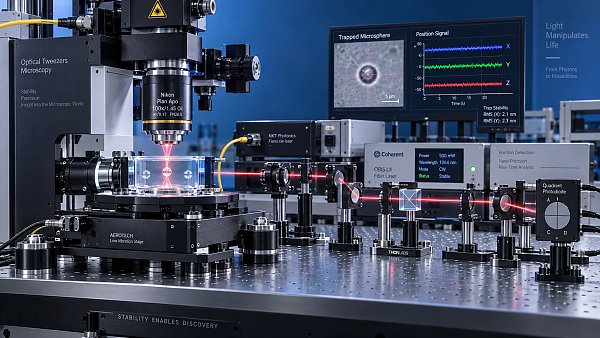
Optical tweezers use a tightly focused laser beam to exert forces on microscopic objects. Producing a stable trap is only part of the engineering task. Measuring those forces, controlling displacement, observing the sample, and maintaining stability over an experiment introduce additional hardware and integration requirements.
The following allowances illustrate different purchasing scopes. They are intended for preliminary budgeting in US dollars, exclude taxes and import charges, and should not be treated as current market averages or supplier price lists. Configurations overlap, and individual quotations can fall outside these bands.
The useful interpretation is not that a particular experiment belongs automatically in a price band. It is that purchasing scope must be settled before a number becomes meaningful. A laboratory with a compatible microscope, optical table, and experienced instrument developers starts from a different cost base than a facility buying its first complete system.
The capabilities that actually change the quotation
Trapping configuration and experimental geometry
A single trap can be sufficient for holding a particle, studying its motion, or measuring interactions against a fixed surface. Dual-trap arrangements can support experiments in which a molecule or structure is suspended between two trapped objects. Multiple independently controlled traps or holographic trapping add further optical and control requirements.
Trap count alone does not describe capability. Ask whether traps can move independently, how laser power is shared, whether movement affects detection, and what performance remains available when all required traps operate simultaneously. A system capable of displaying several trapped particles is not necessarily configured for simultaneous quantitative force measurements on each one.
Force measurement rather than trapping alone
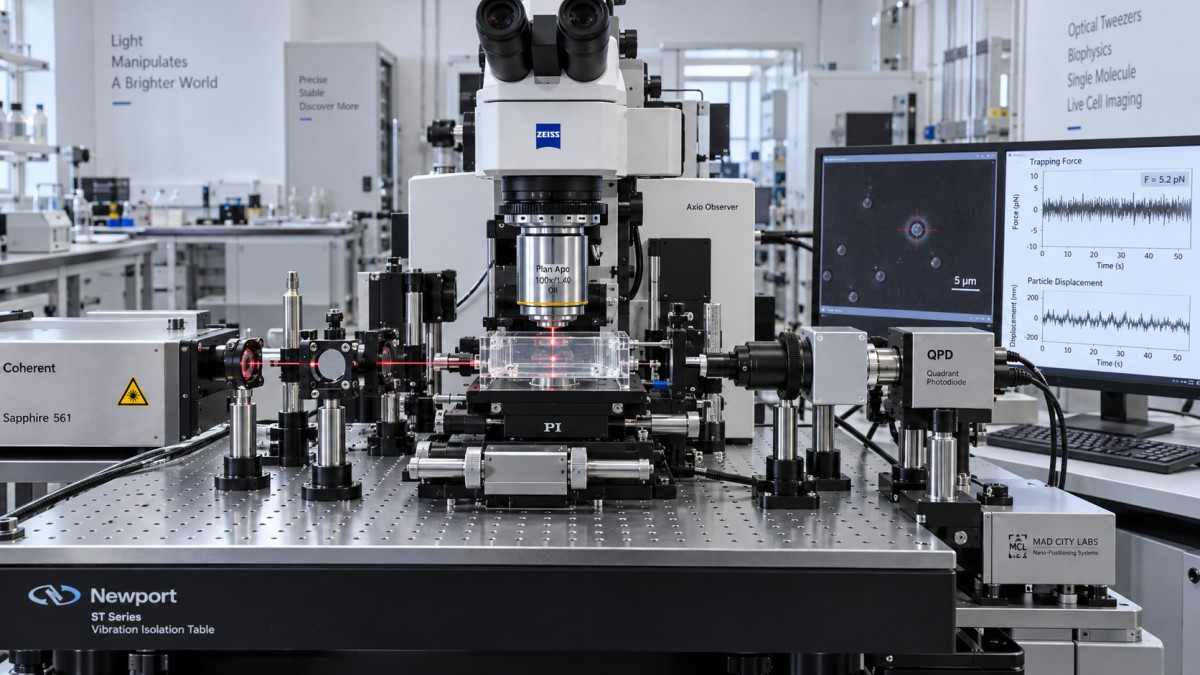
Quantitative force measurement requires a method for detecting displacement or momentum change and a calibration procedure appropriate to the experiment. Back-focal-plane detection, for example, can provide rapid position measurements using dedicated detectors, but its performance depends on the optical arrangement, electronics, sample, and calibration conditions.
For measurements based on trap stiffness, force is inferred from displacement within the calibrated operating region. Uncertainty therefore depends on both displacement measurement and stiffness calibration. Detector resolution by itself is not a complete force-accuracy specification.
Require the quotation to distinguish measurement bandwidth, noise, usable force range, and long-term stability. A high acquisition rate does not guarantee low measurement noise, and a sensitivity figure without a stated bandwidth is difficult to compare. Calibration software is valuable only if its methods and assumptions are suitable for the intended sample conditions.
Imaging and optical compatibility
Basic observation and fluorescence imaging impose different requirements. Fluorescence can require excitation sources, filters, sensitive detectors or cameras, and synchronization with trapping and force acquisition. Combining these functions also introduces possible photobleaching, background signals, and sample heating concerns.
Objective selection deserves particular attention. Numerical aperture, working distance, immersion medium, transmission at the trapping wavelength, and compatibility with the sample chamber all affect performance. Reusing an existing microscope reduces expenditure only if its optical path and mechanical structure support the required configuration.
Positioning, feedback, and automation
A precision stage can move the sample while beam-steering components move the trap. These functions are not interchangeable. The necessary travel range, response speed, positional stability, and control architecture depend on whether the experiment involves static holding, controlled stretching, rapid perturbation, or long-duration measurements.
Closed-loop force or position control adds requirements beyond a motorized stage. Detector response, processing latency, actuator performance, and software must work together. If a protocol depends on holding a constant force while a specimen changes length, specify the required feedback behavior rather than merely requesting “high-speed control.”
Automation can justify its cost when it reduces repetitive sample capture, alignment, or protocol execution. However, an automated demonstration with standard beads does not establish that the same workflow will work with different particles, chambers, or biological preparations.
A cheaper modular build can carry a larger integration bill
A component-based system can offer flexibility and a lower cash outlay, particularly when suitable infrastructure already exists. Its financial advantage depends on whether the institution can supply the engineering effort needed to assemble, align, calibrate, document, and maintain it.
That work should be budgeted rather than treated as free. Optical design, mechanical fabrication, electronics, software development, and troubleshooting compete with experimental activity. A system that meets its intended specifications only after extensive development has a different effective cost from an installed instrument with contractual acceptance criteria.
Responsibility is another important difference. With components from several suppliers, an unstable measurement may originate in the laser, detector electronics, microscope, stage, or software interface. Each component can satisfy its own specification while the assembled system fails to meet the experimental requirement.
A turnkey premium is therefore most defensible when it buys verified integration, a clear service boundary, and reduced commissioning work. It is less compelling when the proposed package includes costly capabilities that the planned experiments do not use.
Installation costs are part of the instrument decision
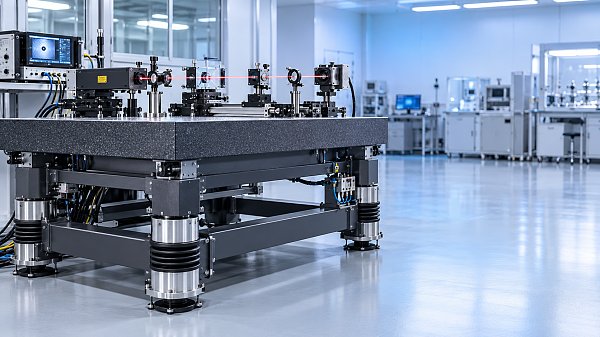
Optical tweezers performance can be limited by vibration, thermal drift, air movement, and electrical noise. Depending on the system and intended measurement, installation may require a vibration-isolated table, enclosure, temperature management, suitable electrical services, or changes to the room layout.
Ask for site requirements before approving the equipment purchase. A supplier should identify the instrument footprint, service clearances, environmental conditions, utility requirements, and any infrastructure that must be provided separately. An optical table listed as optional may still be necessary to reach the quoted performance at the proposed site.
Laser safety also has a budget consequence. Requirements depend on the accessible radiation, enclosure design, operating procedures, and applicable local rules. Protective measures, safety review, training, and controlled servicing arrangements should be considered alongside the instrument—not after delivery.
For an imported system, separate equipment value from freight, insurance, brokerage, applicable duties and taxes, and installation travel. Confirm who handles transport damage claims and whether installation is included at the destination. Currency movements between quotation and payment can also change the final expenditure if the price is denominated in a foreign currency.
Budget for ownership, not just delivery
A useful ownership model includes acquisition, site preparation, commissioning, recurring service, consumables, software costs, internal labor, and an allowance for downtime. These categories should be estimated individually; a generic maintenance percentage can conceal important differences between configurations.
Laser repair or replacement, detector servicing, stage maintenance, and realignment can involve different service arrangements. Establish which components are covered by warranty, whether travel and labor are included, and whether repairs can be performed locally. A warranty that requires returning a major assembly overseas may create substantial interruption even when the repair itself is covered.
Software terms also affect usable life. Confirm whether licenses are perpetual or subscription-based, whether analysis seats cost extra, and which updates are included. Access to raw measurements and calibration metadata matters if experiments will be analyzed outside the supplier’s software. Proprietary export limitations can create additional processing work or complicate future migration.
Consumables vary with the experiment. Beads, functionalization reagents, sample chambers, microfluidic devices, and biological preparations may all contribute to operating cost. Calculate these costs per attempted experiment as well as per successful measurement, especially when sample preparation is demanding.
Training should cover more than starting the instrument. Alignment checks, calibration, troubleshooting, sample loading, and recognition of measurement artifacts influence how quickly a system becomes productive. The proposal should state the training duration, content, number of participants, and availability of follow-up assistance.
Make supplier quotations comparable through acceptance conditions
The strongest way to compare proposals is to define a representative experiment and specify what the delivered system must demonstrate. This connects spending to usable capability rather than to an impressive list of components.
An acceptance specification can include:
- The particle size, sample medium, chamber geometry, and temperature conditions used for testing.
- The required trap configuration and independently controllable movements.
- Force and displacement performance, with measurement bandwidth and filtering stated.
- Allowable drift over a defined measurement duration.
- Simultaneous imaging and force acquisition under the required operating conditions.
- Calibration procedures, raw-data export, and documentation supplied at handover.
Numerical thresholds should come from experimental needs, not from whichever brochure offers the smallest number. Measuring slow changes over several minutes places different demands on stability than capturing rapid events. Likewise, a demanding fluorescence protocol may make optical compatibility more important than maximum trapping power.
Ask suppliers to identify any specifications demonstrated only under conditions different from the planned experiment. Bead type, viscosity, proximity to a surface, laser power at the sample, and signal processing can affect interpretation. Acceptance testing should make those conditions explicit.
Where additional spending is justified
Higher expenditure is justified when a capability removes a specific experimental limitation: a second trap enables the required geometry; feedback supports the intended force protocol; fluorescence links mechanical behavior to an optical signal; or automation increases the number of usable measurements within available operating time.
Conversely, maximum laser power, additional imaging channels, or extensive automation should not be purchased solely as protection against unspecified future needs. Higher power can increase thermal loading, additional optical paths can complicate alignment, and more software-controlled functions can increase maintenance dependencies.
Future expansion is worth paying for when the upgrade path is concrete. Request compatibility commitments, required hardware changes, licensing implications, and an indicative upgrade scope. “Upgradeable” is not financially meaningful if expansion later requires replacing the microscope, detection architecture, or controller.
The appropriate budget is the cost of a configuration that can complete the required experiment under agreed conditions, plus the infrastructure and support needed to sustain it. A lower quotation is genuinely better value only when those boundaries remain equivalent. Before committing funds, obtain an itemized configuration, a site-preparation estimate, ownership-cost assumptions, and measurable acceptance terms; together, they turn an optical tweezers price into a defensible investment decision.
Recent Articles
 2026.10.14How air pressure affects precision pneumatic actuator repeatabilityPrecision Pneumatic actuator repeatability depends on more than supply pressure. Discover how pressure, friction, and flow affect positioning—and how to improve consistency in your application.
 2026.10.13How to choose a packaging manufacturer for small production runsChoose a packaging manufacturer for small production runs with confidence. Discover how to compare costs, verify samples, and secure quality packaging without excess inventory.
 2026.10.12Ultra-Pure Chemicals in Latin America: What Shapes Regional Supply and Demand?Ultra-pure chemicals Latin America: explore demand drivers, qualified supply, and purity risks to uncover smarter sourcing and investment opportunities.
 2026.10.12How Much Does an Optical Tweezers System Cost?Explore optical tweezers system price ranges, key cost drivers, and ownership expenses. Compare configurations and learn how to choose the right setup for your research budget.
 2026.10.12How to size commercial refrigerators for a restaurant kitchenDiscover how commercialrefrigerators should be sized for peak demand, smarter workflow, food safety, and reliable restaurant kitchen performance.
 2026.10.11How procurement planning reduces supply risk in Latin AmericaProcurement planning Latin America helps reduce supply risk with supplier qualification, import readiness, inventory controls, and contingency sourcing.
 2026.10.10How to build a supplier capability evaluation scorecard for critical partsSupplier capability evaluation scorecard: build a risk-based framework with gates, evidence, and weighted criteria to qualify critical-part suppliers with confidence.
 2026.10.09When do sub micron pneumatic actuators improve metrology repeatability?Sub micron pneumatic actuators for metrology improve repeatability by reducing friction, controlling contact force, and accelerating settling time. Discover when they deliver measurable inspection gains.
 2026.10.08How to assess measurement uncertainty from a precision metrology supplierPrecision metrology supplier guide: assess measurement uncertainty, traceability, environmental effects, calibration, and decision rules for reliable results.
 2026.10.07Metrology application notes for choosing CMM probe strategiesMetrology application notes for selecting CMM probe strategies, improving accuracy, access, repeatability, and confidence in complex feature inspection.
 2026.10.06What refresh rate do VR headsets need to reduce motion sicknessVR headsets need at least 90Hz to help reduce motion sickness. Discover why stable frame rates, low latency, and 120Hz support can deliver smoother, more comfortable VR experiences.
 2026.10.05What drives nano-indentation systems cost for a new lab?Nano-indentation systems cost: discover the real budget drivers for a new lab, from configuration and site readiness to software, calibration, and service.
 2026.10.04When does a micro fluidic probe OEM need custom channel geometry?Micro fluidic probe OEM guide: learn when custom channel geometry improves confinement, shear control, reagent savings, and process reliability.
 2026.10.03How to prevent cross-contamination in semiconductor gas handlingSemiconductor Gas Handling best practices to prevent cross-contamination, protect gas purity, improve process stability, and strengthen fab safety.
 2026.10.02How healthcare engineering improves the accuracy of diagnostic equipmentHealthcare engineering improves diagnostic accuracy through precision design, calibration, fluid control, and traceable validation for reliable clinical results.
 2026.10.01When does a steel-frame vibration isolation table provide enough stability?Vibration isolation table steel frame stability explained: assess stiffness, resonance, payload, and isolator performance for precise, reliable measurements.
 2026.09.30How probe station procurement alerts prevent costly supply delaysProbe station procurement alerts help teams spot configuration risks, lead-time changes, and compliance issues early—protecting test schedules and avoiding costly supply delays.
 2026.09.29How Can Procurement Planning Reduce Single-Source Supply Risk?How can procurement planning reduce single-source supply risk? Discover practical strategies for qualifying alternatives, mapping dependencies, building buffers, and protecting critical operations.
 2026.09.29What Should a Precision Manufacturing Supplier Audit Include?What should be included in a precision manufacturing supplier audit? Explore essential checks for process capability, metrology, traceability, and risk control.
 2026.09.29How Do Export Controls Affect Semiconductor Equipment Lead Times?How do export controls affect semiconductor equipment lead times? Discover licensing, screening, supplier, and service risks—and plan smarter to protect fab schedules.
 2026.09.29What Maintenance Does a Micro-Manipulation System Need?What maintenance does a micro-manipulation system need? Explore calibration, cleaning, motion checks, cable care, and environmental controls for reliable precision.
 2026.09.29Microdynamics in Precision Motion: What Engineers Need to MeasureMicrodynamics in precision motion: learn what engineers must measure to control vibration, settling, friction, compliance, and servo response for reliable nanometer-level results.
 2026.09.29OEM Nanopositioning Solutions: Specifying Travel, Load, and Control RequirementsOEM nanopositioning solutions guide: specify usable travel, real payload dynamics, feedback, and control integration for reliable precision instruments.
 2026.09.29Factory-Price Photoresist Chemicals: What Buyers Should Verify Before OrderingFactory price photoresist chemicals: learn the essential checks for process fit, lot control, purity, packaging, and total cost before ordering.
 2026.09.29When Does Laser Interferometer Precision Limit a Metrology System?Laser interferometer precision: learn when it limits metrology systems, from air-path effects and alignment errors to uncertainty budgets and smarter upgrades.
 2026.09.29Selecting a Semi-Automatic Wafer Prober for Low-Volume Test LinesChoose a semi automatic wafer prober for low-volume test lines with guidance on contact stability, flexible wafer handling, probe compatibility, and repeatable workflows.
 2026.09.29Piezo Valves for Fast Gas Dosing: Matching Response Time to Process NeedsPiezo valves for fast gas dosing: learn how to match response time, pressure conditions, and system design for stable, repeatable process control.
 2026.09.29Why a Piezo Valve Loses Repeatability—and How to Diagnose ItPiezo valve repeatability issues? Learn how to diagnose drive signals, contamination, pressure instability, bubbles, and wear before costly replacement.
 2026.09.29Nanopositioning Stages: Comparing Direct-Drive and Piezo-Flexure DesignsNanopositioning stages compared: explore direct-drive and piezo-flexure designs for travel, stiffness, settling time, thermal stability, and precision control.
 2026.09.29ArF Photoresist in Vietnam: Supply-Chain Risks for Semiconductor FabsArF photoresist in Vietnam: uncover supply-chain, compliance, logistics, and qualification risks. Build resilient sourcing strategies for semiconductor fabs.
 2026.09.29Ultra-Pure Silane Gas in the Middle East: Purity and Delivery ChecksUltra-pure silane gas Middle East acceptance guide: verify purity, CoA traceability, cylinder integrity, and safe delivery controls for critical processes.
 2026.09.29How Web Tension and Oven Zoning Affect Coating Calendering Line QualityCoating calendering line quality depends on stable web tension and precise oven zoning. Learn how to reduce gloss, gauge, adhesion, and embossing defects.
 2026.09.29How high stability optical tweezers reduce drift in long experimentsOptical tweezers high stability systems reduce long-experiment drift through rigid mechanics, thermal control, low-noise optics, and meaningful feedback. Explore evaluation methods.
 2026.09.28How piezo polymer materials affect sensitivity in flexible sensorsPiezo polymer materials shape flexible sensor sensitivity. Explore stress transfer, film stability, electronics, and testing insights for reliable high-performance designs.













FILTER_CORE
REF_NO: 0042
Editors' Picks