
2026 Second National Low-Altitude Economy Conference Opens
On May 13, 2026, the Second National Low-Altitude Economy Development Conference opened in Hangzhou, announcing a landmark customs facilitation agreement between China’s General Administration of Customs and the customs authorities of five Central Asian countries. The move directly impacts manufacturers and exporters of precision low-altitude intelligent equipment—including probe stations and micro-robots—by significantly accelerating cross-border clearance for eVTOL battery testing and flight control validation systems.
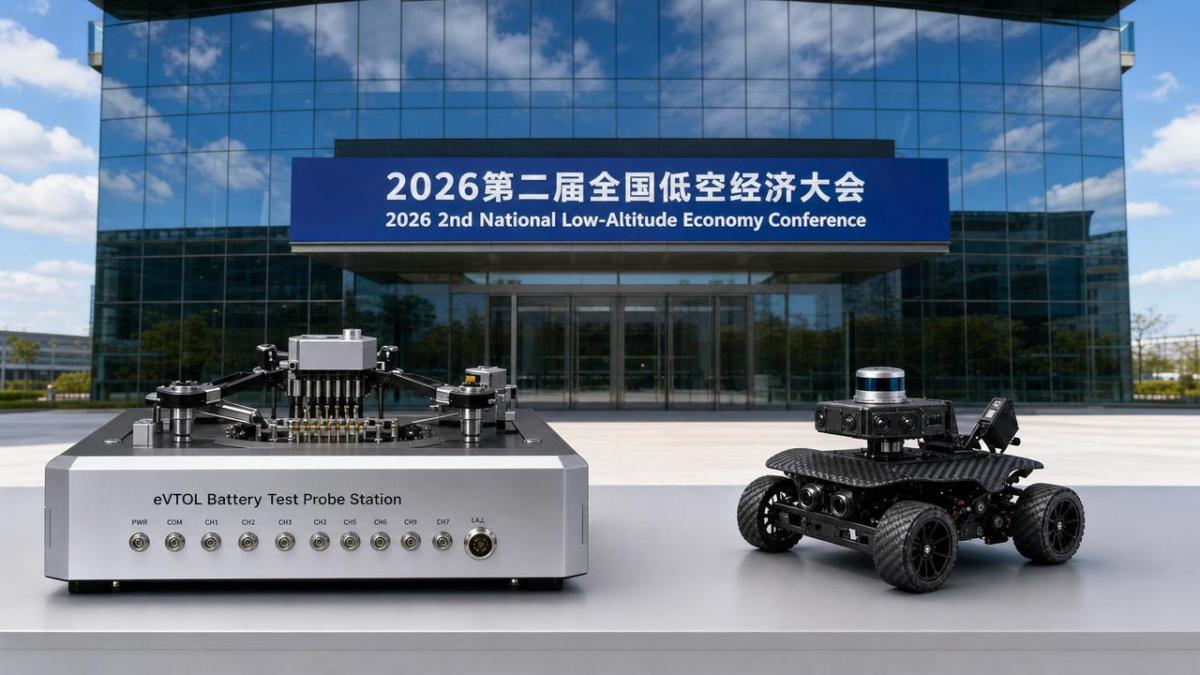
Event Overview
The conference, held on May 13, 2026 in Hangzhou, confirmed the signing of the Memorandum of Cooperation on Rapid Clearance for Low-Altitude Intelligent Equipment between China’s General Administration of Customs and the customs administrations of Kazakhstan, Uzbekistan, Kyrgyzstan, Tajikistan, and Turkmenistan. Under the agreement, probe stations and micro-robots used in eVTOL battery testing and flight control verification are granted a ‘pre-approved whitelist + direct port release’ channel. Average customs clearance time has been reduced from 14 days to within 72 hours. Importers in Central Asia may now file declarations using only the Chinese manufacturer’s Technical Compliance Statement for Low-Altitude Equipment, without prior third-party certification or pre-shipment inspection.
Industries Affected
Direct trading enterprises—particularly Chinese exporters of probe stations and micro-robots targeting Central Asian markets—are immediately impacted. The shortened clearance window reduces inventory holding costs, improves order-to-revenue cycles, and lowers working capital pressure. However, eligibility hinges on accurate technical documentation and adherence to whitelist criteria; misclassification or incomplete compliance statements may trigger manual review, offsetting time gains.
Raw material procurement enterprises—especially those sourcing high-precision components (e.g., RF probes, MEMS actuators, thermal calibration modules) from global suppliers for final assembly in China—are indirectly affected. Faster export lead times increase demand predictability, enabling tighter procurement scheduling. Yet, any upstream delay in component delivery now carries higher opportunity cost, as bottlenecks can no longer be masked by long customs processing windows.
Manufacturing enterprises—including OEMs and contract manufacturers producing probe stations for eVTOL supply chains—face revised quality documentation requirements. The Technical Compliance Statement must reflect not only functional specifications but also traceable test protocols aligned with eVTOL airworthiness verification standards (e.g., DO-160G Section 22 for vibration, RTCA/DO-160G Section 21 for temperature). This elevates internal QA rigor and may necessitate updated test lab accreditation.
Supply chain service enterprises—such as customs brokers specializing in high-tech equipment, logistics providers offering bonded warehousing near ports like Shanghai Yangshan or Ningbo-Zhoushan, and technical translation/localization firms—see new service opportunities. Demand is rising for bilingual (Chinese–English–Russian) compliance packaging, pre-clearance audit support, and real-time status tracking integrated with China’s Single Window system. However, differentiation will increasingly depend on domain expertise in low-altitude aviation hardware—not just general customs procedures.
Key Considerations and Recommended Actions
Verify whitelist eligibility criteria before shipment
Manufacturers must confirm whether their specific probe station model (including firmware version, sensor resolution, and calibration certificate validity) meets the technical parameters defined in the bilateral annexes. The whitelist is product-line-specific—not company-wide—and requires annual revalidation.
Standardize and localize the Technical Compliance Statement
The statement must include verifiable test reports (e.g., ISO/IEC 17025-accredited labs), declared operating environmental ranges, and explicit linkage to eVTOL subsystem validation use cases. Translations into Russian and English are mandatory for Central Asian submissions; machine-translated documents have been rejected in early pilot cases.
Integrate customs data exchange with ERP systems
To leverage the 72-hour target, exporters should connect their enterprise resource planning platforms to China’s Single Window via API-enabled interfaces. Manual entry remains permissible but introduces latency risk—especially during peak filing periods at border checkpoints.
Monitor evolving harmonized system (HS) code classifications
Probe stations for aerospace applications are currently classified under HS 9030.89 (‘other measuring instruments’), but Central Asian customs authorities are reviewing sub-categorization for low-altitude-specific hardware. A future HS code revision could affect duty rates or licensing thresholds.
Editorial Perspective / Industry Observation
Observably, this agreement marks the first multilateral customs framework explicitly designed for low-altitude intelligent hardware—not merely drones or airframes, but the underlying test and verification infrastructure. Analysis shows that the focus on probe stations signals recognition of their role as ‘enablers of airworthiness’: without standardized, rapidly deployable test platforms, eVTOL certification timelines remain bottlenecked. From an industry perspective, this is less about trade liberalization per se and more about synchronizing regulatory readiness across emerging low-altitude ecosystems. Current evidence suggests Central Asian regulators are modeling their own airworthiness frameworks after China’s CAAC Special Conditions for eVTOL (CCAR-21 Amendment 2025), making technical alignment—not just tariff reduction—the true driver of efficiency gains.
Conclusion
This initiative does not represent a broad-based tariff cut, but rather a targeted regulatory coordination mechanism for mission-critical ground support hardware. Its significance lies in establishing a precedent: where safety-critical verification tools gain priority treatment, broader low-altitude industrial scaling becomes operationally feasible. For global suppliers, it underscores that compliance investment—in documentation, testing, and localization—is increasingly a competitive differentiator, not just a regulatory hurdle.
Source Attribution
Official announcement issued by the General Administration of Customs of the People’s Republic of China and the Ministry of Commerce of the PRC, released during the Second National Low-Altitude Economy Development Conference, Hangzhou, May 13, 2026. Annexes to the Memorandum—including technical scope definitions, whitelist application procedures, and sample compliance statement templates—are published on the GACC website (www.customs.gov.cn) under Notice No. 2026-47. Note: Implementation details for Tajikistan and Turkmenistan remain pending formal domestic ratification; ongoing monitoring advised.
Taglist:
Recent Articles
 2026.09.25Which ISO standards apply to precision-engineered medical devices?ISO standards for precision engineering medical devices: explore ISO 13485, ISO 14971, metrology, biocompatibility, sterilization, and packaging requirements.
 2026.09.24How to choose athletic clothing that stays comfortable in humid weatherAthletic clothing for humid weather: learn how to choose breathable fabrics, low-chafe fits, and quick-drying layers for more comfortable workouts.
 2026.09.23How sheet metal welding choices affect dimensional accuracySheet metal welding choices shape dimensional accuracy. Explore heat input, joint design, fixturing, and inspection strategies to reduce distortion and improve repeatability.
 2026.09.22How specification preparation prevents flow-control errors in process systemsSpecification preparation for process systems prevents flow-control errors by defining operating ranges, pressure budgets, accuracy, materials, and control requirements before equipment selection.
 2026.09.21How to assess a German mass flow controller supplier for cleanroom useIndustrial & Manufacturing equipment supplier in Germany: assess cleanroom MFC partners for gas compatibility, leak integrity, calibration traceability, and lifecycle service.
 2026.09.20How to assess aerospace component manufacturing services for tight tolerancesAerospace component manufacturing services: learn how to verify tight-tolerance capability through metrology, process control, special-process oversight, and traceability.
 2026.09.19When does polycarbonate roofing need UV protection on both sides?Polycarbonateroofing: learn when dual-sided UV protection prevents yellowing, installation errors, and reflected-light damage in demanding roof designs.
 2026.09.18When high precision coordinate measuring machines justify tighter tolerancesHigh precision coordinate measuring machines justify tighter tolerances when uncertainty, process capability, and traceability protect critical performance. Explore smarter decisions.
 2026.09.17How can retailers verify safety before buying Montessori toys wholesale?Montessoritoyswholesale safety guide: verify SKU-specific tests, labels, traceability and market compliance before ordering.
 2026.09.16How to assess surgical instruments for reliable sterilizationAssess surgical instruments for reliable sterilization with practical guidance on cleanability, material compatibility, inspection, and validated reprocessing.
 2026.09.15How material science for food ingredients improves shelf stabilityMaterial Science for food ingredients reveals how moisture control, encapsulation, oxidation management, and smart packaging extend shelf life and protect quality.
 2026.09.14What purity specification do laboratory gases need for trace analysis?Ultra-high purity gases for laboratory use: learn how to specify, verify, and control critical impurities for reliable trace analysis and lower backgrounds.
 2026.09.13How to verify a lubricants exporter’s product quality before orderingLearn how to verify a lubricants exporter before ordering—from batch CoAs and lab tests to traceability, packaging, and export compliance. Reduce equipment and shipment risks.
 2026.09.12When does export control compliance training need to be refreshed?Export control compliance training: learn when annual and event-driven refreshers are needed to manage regulatory, product, access, and supply-chain risks.
 2026.09.11What makes a diaper bag backpack comfortable for all-day outings?Discover how a diaperbagsbackpack delivers all-day comfort with padded straps, breathable support, smart storage, and balanced capacity for stress-free outings.
 2026.09.10How nano-positioning stages enable sub-nanometer manufacturing precisionSub-nanometer manufacturing demands more than fine resolution. Discover how nano-positioning stages deliver stable, accurate motion through advanced feedback, control, and error management.
 2026.09.09How to validate biological implants for biocompatibility riskBiological implants validation: learn how to assess biocompatibility risk with ISO 10993, chemical characterization, and manufacturing controls.
 2026.09.08What to verify before selecting an XYZ translation stage OEM factoryXYZ translation stage OEM factory selection guide: verify volumetric accuracy, payload stiffness, traceable testing, controls, and acceptance criteria before ordering.
 2026.09.07How to match mining equipment to different extraction conditionsMining equipment selection made practical: match machines to rock, mine geometry, ground conditions, capacity, energy, and maintenance needs for safer, more productive extraction.
 2026.09.07Global photonics alignment market analysis: what is driving demand?Global photonics alignment market analysis: discover how semiconductor packaging, optical communications, sensing, and automation are driving demand for scalable, high-yield alignment solutions.
 2026.09.05When do Ultra-Precision Engineering consulting services add value?Ultra-Precision Engineering consulting services help buyers reduce qualification risk, validate real-world performance, and control lifecycle costs before committing to complex suppliers.
 2026.09.04How to choose a nano-indentation system for reliable hardness testingLearn how to choose a nano-indentation system for hardness testing with confidence. Compare calibration, load control, drift stability, test modes, data quality, and application fit for reliable results.
 2026.09.03When does a bridge CMM outperform a portable measuring arm?CMM systems: discover when a bridge CMM delivers superior repeatability, tighter uncertainty control, and dependable inspection results over a portable measuring arm.
 2026.09.02How does industrial innovation analysis guide technology choices?Industrial Innovation analysis helps manufacturers choose technologies with confidence by evaluating performance, integration, compliance, and lifecycle risks. Discover a smarter decision framework.
 2026.09.01How precise must micro-manipulation systems be for microassembly?Micro-manipulation systems for microassembly: learn how to match precision, repeatability, feedback, and error budgets to achieve reliable, high-yield assembly.
 2026.08.31What to verify before choosing a wafer probe station exporterWafer probe station exporter selection starts with verified performance, integration, export readiness, and lifecycle support. Learn what to check before you buy.
 2026.08.30When does pulse welding improve precision in a micro-welding workstation?Micro-welding workstation pulse welding improves precision by controlling heat, reducing variation, and protecting delicate assemblies. Discover when it delivers measurable results.
 2026.08.29When does machine learning improve defect detection in CMM inspection?Machine learning improves CMM defect detection when measurement data is stable, traceable, and actionable. Learn how to spot early drift, prioritize risk, and strengthen quality decisions.
 2026.08.28How to compare nano-fabrication tools in North America for probe-station workCompare nano-fabrication tools North America labs use for probe-station work—evaluate motion, optics, touchdown control, thermal stability, and service support.
 2026.08.27When does biomass energy make financial sense for industrial heat?Biomass energy can cut industrial heat costs when demand, fuel supply, logistics, and compliance align. Explore the key financial tests for a resilient investment.
 2026.08.26What to check before choosing an OEM PZT driver manufacturerPZT driver manufacturer OEM selection starts with application fit. Learn what to check on stability, load matching, compliance, and lifecycle support before you buy.
 2026.08.25What a battery management system must monitor to prevent cell failureBattery management system essentials: learn what to monitor at cell level—voltage, current, temperature, SOC, balancing, and deviation trends—to prevent cell failure and improve battery safety.
 2026.08.24How long do hybrid car parts last before replacement becomes likelyHybrid car parts do not all wear out at the same pace. Learn the warning signs, lifespan factors, and when replacement is truly likely before costs rise.
 2026.08.23How to tell if an exporters directory is reliable before you use itExporters directory reliability starts with transparency. Learn how to spot verified data, fresh listings, and red flags before trusting any platform for sourcing.















FILTER_CORE
REF_NO: 0042
Editors' Picks
- 00
0000-00
Which ISO standards apply to precision-engineered medical devices? - 00
0000-00
How to choose athletic clothing that stays comfortable in humid weather - 00
0000-00
How sheet metal welding choices affect dimensional accuracy - 00
0000-00
How specification preparation prevents flow-control errors in process systems