
Laser Interferometer Measurement Range: Limits That Affect Accuracy
Understanding laser interferometer measurement range is essential for quality control and safety teams working with ultra-precision systems. From thermal drift and beam alignment to environmental vibration and refractive index variation, range limits can directly influence measurement accuracy, compliance confidence, and process stability. This article examines the key constraints that matter most in high-spec industrial environments.
For most industrial users, the practical answer is simple: measurement range is not only the maximum distance a laser interferometer can cover. It is the distance over which it can still deliver the accuracy, repeatability, and traceability your process requires.
That distinction matters for quality control personnel validating tolerances and for safety managers protecting process reliability. A system may be able to measure a long axis physically, yet fail to maintain acceptable uncertainty under real plant conditions.
In other words, the true limit is usually set less by optics alone and more by the combined effect of environment, machine dynamics, installation quality, and calibration discipline. This is where procurement decisions and compliance outcomes are often won or lost.
What does laser interferometer measurement range really mean in practice?
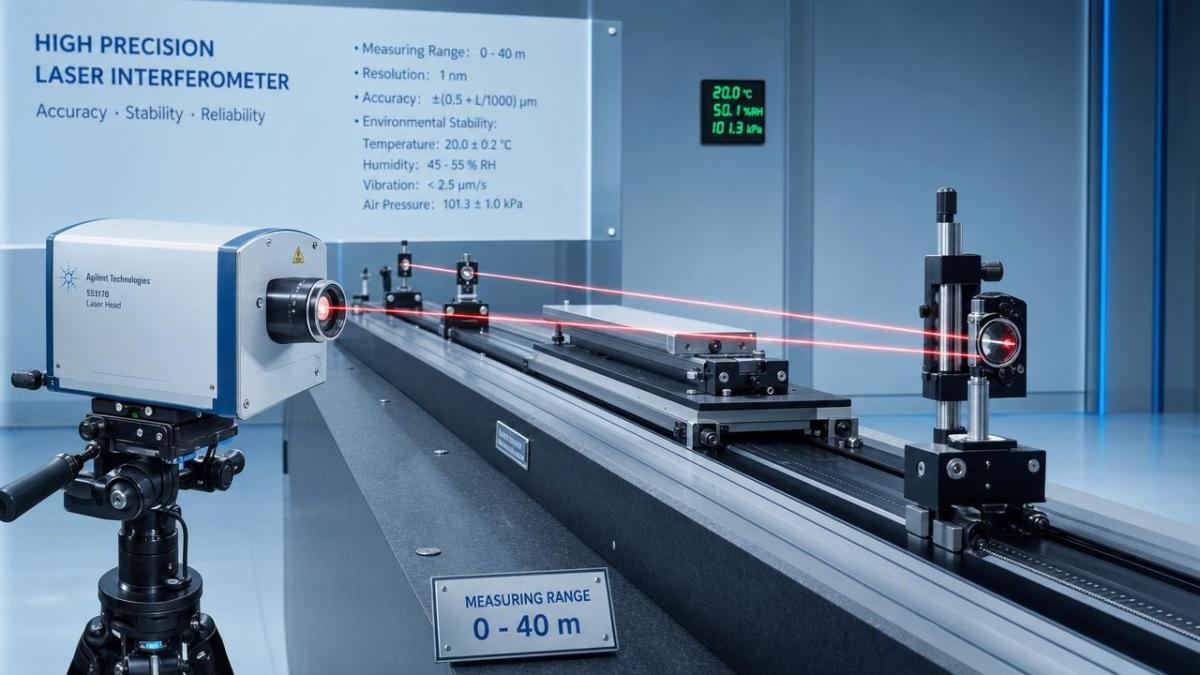
When engineers discuss laser interferometer measurement range, they may mean different things. One definition is geometric range, or the maximum beam path the system can physically support without losing signal entirely.
A second and more useful definition is effective measurement range. This is the span over which the instrument remains within specified uncertainty, maintains stable fringe detection, and supports the intended metrology task under operating conditions.
For quality teams, effective range is the more relevant metric. A 10-meter measurement path means little if refractive index drift, Abbe offset, or poor alignment pushes uncertainty beyond the allowable process window.
For safety and operational assurance teams, range also relates to control confidence. If a stage, gantry, or machine tool is being verified over long travel, hidden range-related error can affect both acceptance testing and ongoing machine integrity.
This is why a specification sheet should never be read in isolation. Range must always be interpreted alongside accuracy over distance, environmental compensation capability, mounting constraints, and the actual metrology architecture of the system.
Why do quality control and safety teams care more about limits than nominal range?
In precision manufacturing, nominal capability rarely equals usable capability. A laser interferometer may function across a stated distance, but the operational question is whether results remain defensible during calibration, validation, or production troubleshooting.
Quality control personnel need measurement data that can stand up to audits, customer reviews, and internal root-cause investigations. If a long-range measurement is degraded by environmental effects, the resulting data may be technically collected but not decision-grade.
Safety managers have a related concern. In advanced motion platforms, poor measurement reliability over travel can hide machine instability, axis drift, or thermal growth, increasing the chance of process failure or unintended equipment behavior.
This is especially important in aerospace, semiconductor, optics, and medical device production. In these sectors, a small error accumulated over a longer path can trigger nonconformance, scrap, rework, or qualification delays with major financial consequences.
So the real priority is not asking, “How far can the interferometer measure?” The right question is, “At what distance do environmental and system effects begin to compromise the decisions we need to make?”
The main factors that limit laser interferometer measurement accuracy over range
The first major factor is air refractive index variation. Laser interferometers measure through air, and air is not stable. Temperature, pressure, humidity, and gas composition all affect the optical path length seen by the beam.
As range increases, small atmospheric changes create larger cumulative error. Even when the laser source is highly stable, the medium itself introduces uncertainty. This is one of the most important practical limits in shop-floor and large-axis applications.
The second factor is thermal behavior of the machine and surrounding structure. Long travel systems often experience temperature gradients, localized heating from motors, and expansion of machine members that can distort measured displacement.
Third is beam alignment. Angular misalignment, cosine error, and offset geometry can all reduce effective accuracy. Over short distances, these issues may appear manageable. Over longer distances, they become increasingly sensitive and harder to control consistently.
Fourth is vibration and dynamic disturbance. Floor vibration, nearby machinery, pneumatic pulses, and moving cable chains can destabilize the optical path or target motion. This creates noise, signal dropouts, or dynamic errors that worsen with speed and travel length.
Fifth is target quality and reflectivity. Retroreflectors, mirrors, and mounting hardware must preserve signal integrity across the intended range. Surface contamination, angular deviation, and mechanical looseness can all reduce measurement confidence.
Finally, electronic resolution is rarely the only issue, but signal processing, fringe counting reliability, and compensation logic still matter. A high-resolution readout does not guarantee trustworthy long-range performance if the physical measurement chain is unstable.
How environmental conditions reduce usable range faster than many teams expect
Environmental control is often the deciding factor between acceptable and misleading results. In climate-controlled metrology rooms, laser interferometers can maintain strong performance over longer paths because thermal and atmospheric variability are tightly managed.
On production floors, however, the situation changes quickly. Airflow from HVAC systems, operator movement, machine heat, open doors, and daily temperature swings can all alter the refractive index enough to affect long-path measurements.
One common mistake is relying on a laboratory-style specification in a mixed-use industrial environment. Vendors may state excellent accuracy values, but those figures often assume stable conditions that are not present near active equipment.
Even localized thermal plumes matter. Warm motors, spindle housings, electronics cabinets, and lighting can create air gradients that distort the beam path. Because these gradients are not always visible, teams may misdiagnose the error as machine drift.
Humidity and pressure compensation can help, but compensation is only as good as sensor placement and update quality. If sensors do not represent the actual beam path environment, corrected data may still carry significant residual uncertainty.
For this reason, quality teams should treat environmental mapping as part of range validation. Safety teams should also document how seasonal and operating-state changes affect reliability, especially for long-axis verification and critical machine acceptance tests.
Installation and alignment errors that quietly shrink effective range
Many range problems originate not in the interferometer itself, but in installation quality. A technically capable system can underperform if the optical setup, machine reference geometry, or mounting stability are not properly controlled.
Cosine error is a classic example. If the laser beam is not exactly aligned with the axis of motion, measured displacement becomes smaller than true displacement. This error grows with misalignment and becomes more consequential over longer travel.
Abbe error is equally important. When the measurement line is offset from the functional point of interest, angular motion in the machine converts into linear measurement error. This is especially relevant for stages, CMM axes, and long-travel positioning systems.
Mounting stiffness also matters. If optics, reflectors, or brackets move under vibration or thermal load, the interferometer may report changes that reflect fixture behavior rather than actual machine displacement. This can distort both calibration and troubleshooting results.
Another overlooked issue is beam path obstruction or signal weakening near travel extremes. Cable carriers, guards, lubrication mist, and mechanical structures may interfere with signal quality only at certain positions, creating range-dependent inconsistency.
For practical validation, teams should test not only center-travel performance but also edge-of-travel behavior, reversal points, and different machine operating states. Effective range must be confirmed across the full use case, not inferred from a static setup.
How to evaluate whether a stated measurement range is credible for your application
Start by defining the decision the measurement must support. Are you calibrating positioning accuracy, verifying bidirectional repeatability, confirming thermal drift, or documenting compliance for a customer or regulator? The application determines the acceptable uncertainty budget.
Next, compare the required tolerance with the full measurement chain, not only the interferometer headline specification. Include environmental compensation, alignment uncertainty, machine dynamics, fixture stability, and operator method in the assessment.
Ask vendors for accuracy over distance under conditions similar to your own environment. A useful supplier should be able to explain how measurement uncertainty changes with path length, atmospheric stability, and mounting geometry.
Also request guidance on minimum environmental controls. If a system requires tight temperature stability or carefully distributed sensors to maintain stated performance, that requirement should be treated as part of the real cost of usable range.
For critical installations, perform a site acceptance test using representative travel distances and operating conditions. Validation should include repeat runs, different times of day, and machine thermal states to reveal drift or compensation weakness.
From a risk perspective, it is better to accept a shorter validated range with strong confidence than a longer nominal range that cannot support audit-ready or process-critical decisions. Reliability is more valuable than headline capability.
Best practices for extending usable range without compromising accuracy
One of the most effective strategies is improving environmental stability around the beam path. This may include thermal shielding, reduced drafts, better HVAC control, machine warm-up protocols, and physical isolation from strong heat sources.
Another key practice is optimizing beam alignment and regularly verifying it. Teams should document alignment procedures, use stable mounting structures, and include alignment checks in preventive maintenance rather than treating setup as a one-time event.
Use compensation sensors intelligently. Temperature, pressure, and humidity sensors should be positioned to represent actual beam conditions as closely as possible. In large systems, single-point sensing may not reflect path-wide environmental behavior.
Reduce geometric error at the source by minimizing Abbe offsets and controlling angular motion of the axis being measured. Mechanical design, stage stiffness, and error mapping all play a role in preserving accuracy across longer travel.
For dynamic applications, consider whether measurement should occur during motion, during settling, or in staged intervals. Some long-range errors appear mainly under speed or acceleration, so test methods should match real operating profiles.
Finally, maintain traceable calibration and uncertainty documentation. For quality and safety teams, confidence comes not only from good measurements but from being able to explain why those measurements remain valid over the intended range.
Common procurement and audit mistakes related to laser interferometer measurement range
A frequent procurement mistake is selecting a system based on maximum range alone. This can lead to underestimating the environmental infrastructure, alignment effort, and training required to achieve the advertised performance in practice.
Another mistake is overlooking the distinction between resolution and accuracy. A system may display extremely fine increments while still accumulating substantial long-range error from atmospheric drift or geometric misalignment.
Some teams also fail to define acceptance criteria before purchase or installation. Without a clear uncertainty budget and validation method, it becomes difficult to determine whether the interferometer actually supports the intended quality objective.
During audits, weak documentation is another recurring issue. If compensation methods, sensor locations, environmental conditions, or alignment procedures are not recorded, the credibility of long-range measurement data can be challenged.
There is also a safety angle. If machine verification depends on long-path displacement data, then undocumented limitations in effective range may undermine confidence in machine condition assessments and change-control decisions.
Strong governance means connecting metrology capability to documented process risk. The best-performing organizations treat laser interferometer measurement range as a controlled operational parameter, not a static catalog value.
Final assessment: what range limit should matter most?
The most important limit is the point where measurement uncertainty becomes too large for the decision you need to make. That threshold may occur well before the optical system reaches its physical maximum distance.
For quality control teams, this means evaluating range through the lens of traceability, tolerance confidence, and repeatability under real production conditions. For safety managers, it means understanding how range-related errors affect machine assurance and process stability.
If you remember one principle, let it be this: the true laser interferometer measurement range is application-specific. It depends on environment, geometry, motion behavior, compensation quality, and documentation discipline far more than marketing claims suggest.
In ultra-precision settings, the best choice is rarely the longest-range instrument on paper. It is the system whose validated effective range matches your process demands, supports compliant decision-making, and remains reliable in the environment where it must actually work.
Recent Articles
 2026.09.25Which ISO standards apply to precision-engineered medical devices?ISO standards for precision engineering medical devices: explore ISO 13485, ISO 14971, metrology, biocompatibility, sterilization, and packaging requirements.
 2026.09.24How to choose athletic clothing that stays comfortable in humid weatherAthletic clothing for humid weather: learn how to choose breathable fabrics, low-chafe fits, and quick-drying layers for more comfortable workouts.
 2026.09.23How sheet metal welding choices affect dimensional accuracySheet metal welding choices shape dimensional accuracy. Explore heat input, joint design, fixturing, and inspection strategies to reduce distortion and improve repeatability.
 2026.09.22How specification preparation prevents flow-control errors in process systemsSpecification preparation for process systems prevents flow-control errors by defining operating ranges, pressure budgets, accuracy, materials, and control requirements before equipment selection.
 2026.09.21How to assess a German mass flow controller supplier for cleanroom useIndustrial & Manufacturing equipment supplier in Germany: assess cleanroom MFC partners for gas compatibility, leak integrity, calibration traceability, and lifecycle service.
 2026.09.20How to assess aerospace component manufacturing services for tight tolerancesAerospace component manufacturing services: learn how to verify tight-tolerance capability through metrology, process control, special-process oversight, and traceability.
 2026.09.19When does polycarbonate roofing need UV protection on both sides?Polycarbonateroofing: learn when dual-sided UV protection prevents yellowing, installation errors, and reflected-light damage in demanding roof designs.
 2026.09.18When high precision coordinate measuring machines justify tighter tolerancesHigh precision coordinate measuring machines justify tighter tolerances when uncertainty, process capability, and traceability protect critical performance. Explore smarter decisions.
 2026.09.17How can retailers verify safety before buying Montessori toys wholesale?Montessoritoyswholesale safety guide: verify SKU-specific tests, labels, traceability and market compliance before ordering.
 2026.09.16How to assess surgical instruments for reliable sterilizationAssess surgical instruments for reliable sterilization with practical guidance on cleanability, material compatibility, inspection, and validated reprocessing.
 2026.09.15How material science for food ingredients improves shelf stabilityMaterial Science for food ingredients reveals how moisture control, encapsulation, oxidation management, and smart packaging extend shelf life and protect quality.
 2026.09.14What purity specification do laboratory gases need for trace analysis?Ultra-high purity gases for laboratory use: learn how to specify, verify, and control critical impurities for reliable trace analysis and lower backgrounds.
 2026.09.13How to verify a lubricants exporter’s product quality before orderingLearn how to verify a lubricants exporter before ordering—from batch CoAs and lab tests to traceability, packaging, and export compliance. Reduce equipment and shipment risks.
 2026.09.12When does export control compliance training need to be refreshed?Export control compliance training: learn when annual and event-driven refreshers are needed to manage regulatory, product, access, and supply-chain risks.
 2026.09.11What makes a diaper bag backpack comfortable for all-day outings?Discover how a diaperbagsbackpack delivers all-day comfort with padded straps, breathable support, smart storage, and balanced capacity for stress-free outings.
 2026.09.10How nano-positioning stages enable sub-nanometer manufacturing precisionSub-nanometer manufacturing demands more than fine resolution. Discover how nano-positioning stages deliver stable, accurate motion through advanced feedback, control, and error management.
 2026.09.09How to validate biological implants for biocompatibility riskBiological implants validation: learn how to assess biocompatibility risk with ISO 10993, chemical characterization, and manufacturing controls.
 2026.09.08What to verify before selecting an XYZ translation stage OEM factoryXYZ translation stage OEM factory selection guide: verify volumetric accuracy, payload stiffness, traceable testing, controls, and acceptance criteria before ordering.
 2026.09.07How to match mining equipment to different extraction conditionsMining equipment selection made practical: match machines to rock, mine geometry, ground conditions, capacity, energy, and maintenance needs for safer, more productive extraction.
 2026.09.07Global photonics alignment market analysis: what is driving demand?Global photonics alignment market analysis: discover how semiconductor packaging, optical communications, sensing, and automation are driving demand for scalable, high-yield alignment solutions.
 2026.09.05When do Ultra-Precision Engineering consulting services add value?Ultra-Precision Engineering consulting services help buyers reduce qualification risk, validate real-world performance, and control lifecycle costs before committing to complex suppliers.
 2026.09.04How to choose a nano-indentation system for reliable hardness testingLearn how to choose a nano-indentation system for hardness testing with confidence. Compare calibration, load control, drift stability, test modes, data quality, and application fit for reliable results.
 2026.09.03When does a bridge CMM outperform a portable measuring arm?CMM systems: discover when a bridge CMM delivers superior repeatability, tighter uncertainty control, and dependable inspection results over a portable measuring arm.
 2026.09.02How does industrial innovation analysis guide technology choices?Industrial Innovation analysis helps manufacturers choose technologies with confidence by evaluating performance, integration, compliance, and lifecycle risks. Discover a smarter decision framework.
 2026.09.01How precise must micro-manipulation systems be for microassembly?Micro-manipulation systems for microassembly: learn how to match precision, repeatability, feedback, and error budgets to achieve reliable, high-yield assembly.
 2026.08.31What to verify before choosing a wafer probe station exporterWafer probe station exporter selection starts with verified performance, integration, export readiness, and lifecycle support. Learn what to check before you buy.
 2026.08.30When does pulse welding improve precision in a micro-welding workstation?Micro-welding workstation pulse welding improves precision by controlling heat, reducing variation, and protecting delicate assemblies. Discover when it delivers measurable results.
 2026.08.29When does machine learning improve defect detection in CMM inspection?Machine learning improves CMM defect detection when measurement data is stable, traceable, and actionable. Learn how to spot early drift, prioritize risk, and strengthen quality decisions.
 2026.08.28How to compare nano-fabrication tools in North America for probe-station workCompare nano-fabrication tools North America labs use for probe-station work—evaluate motion, optics, touchdown control, thermal stability, and service support.
 2026.08.27When does biomass energy make financial sense for industrial heat?Biomass energy can cut industrial heat costs when demand, fuel supply, logistics, and compliance align. Explore the key financial tests for a resilient investment.
 2026.08.26What to check before choosing an OEM PZT driver manufacturerPZT driver manufacturer OEM selection starts with application fit. Learn what to check on stability, load matching, compliance, and lifecycle support before you buy.
 2026.08.25What a battery management system must monitor to prevent cell failureBattery management system essentials: learn what to monitor at cell level—voltage, current, temperature, SOC, balancing, and deviation trends—to prevent cell failure and improve battery safety.
 2026.08.24How long do hybrid car parts last before replacement becomes likelyHybrid car parts do not all wear out at the same pace. Learn the warning signs, lifespan factors, and when replacement is truly likely before costs rise.
 2026.08.23How to tell if an exporters directory is reliable before you use itExporters directory reliability starts with transparency. Learn how to spot verified data, fresh listings, and red flags before trusting any platform for sourcing.












FILTER_CORE
REF_NO: 0042
Editors' Picks
- 00
0000-00
Which ISO standards apply to precision-engineered medical devices? - 00
0000-00
How to choose athletic clothing that stays comfortable in humid weather - 00
0000-00
How sheet metal welding choices affect dimensional accuracy - 00
0000-00
How specification preparation prevents flow-control errors in process systems