Biological Implants and the Coating Problem Few Specs Catch
In Biological Implants, the smallest coating mismatch can undermine biocompatibility, durability, and compliance long before standard specs reveal the risk. For teams focused on Zero-Defect Manufacturing, Procurement Intelligence, and Regulatory Foresight, this issue mirrors the same hidden failures seen in Aerospace Components and Semiconductor Manufacturing. This article examines why Multidisciplinary Engineering and Industrial Integrity are essential to catching what conventional specifications often miss.
Why implant coating problems escape standard specifications
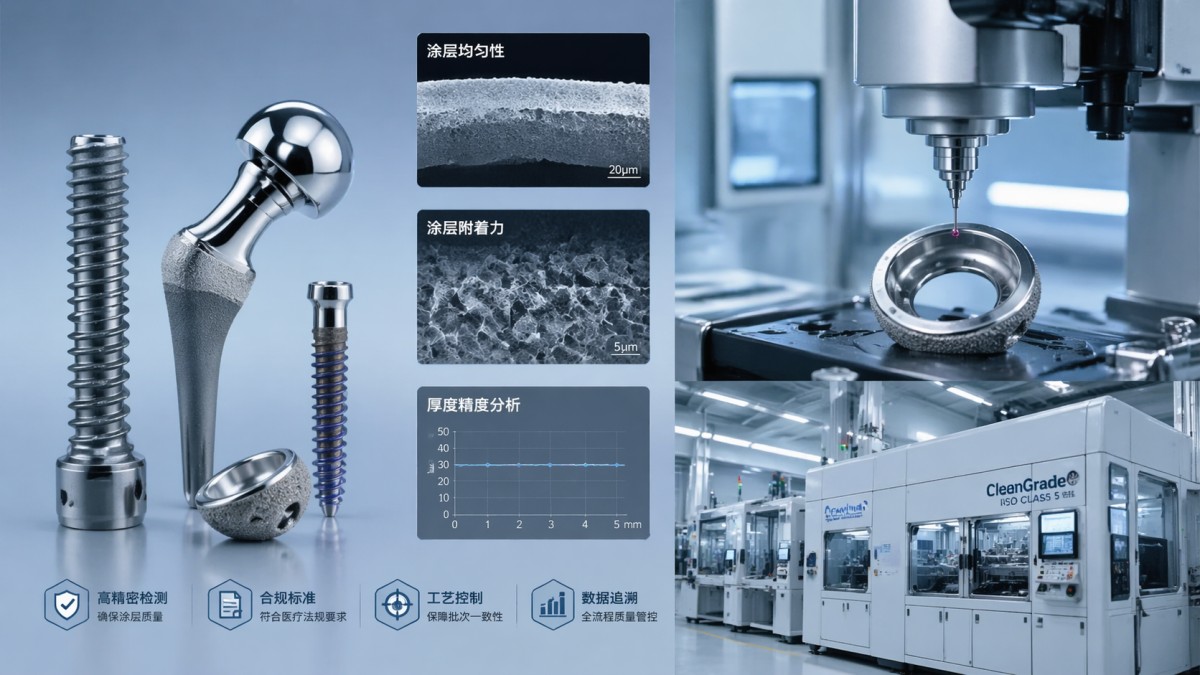
Many biological implant failures do not begin with a dramatic material defect. They begin with a subtle coating mismatch: a thickness drift outside the intended process window, an adhesion weakness at the interface, residual contamination from upstream chemistry, or a surface energy shift that changes tissue response after implantation. In practice, these issues may sit outside standard purchase specifications, even when the datasheet appears complete.
That is why implant coating assessment cannot stop at nominal values such as coating type, average thickness, or base substrate compatibility. Procurement teams, operators, and quality managers need to evaluate at least 4 layers of risk: deposition consistency, interface behavior, cleaning history, and metrology traceability. A specification that covers only the first layer often misses the mechanisms that trigger early wear, delamination, or biocompatibility drift.
This challenge is not unique to medical manufacturing. Aerospace and semiconductor environments have long shown that micron-level or even sub-micron variation can create downstream failure modes that remain invisible during incoming inspection. Biological implants add another constraint: the coating must perform not only mechanically, but also chemically and biologically over time, sometimes across 6–12 months of validation and post-market review cycles.
What conventional specs usually capture—and what they often miss
Standard specifications usually capture material family, target thickness range, roughness requirement, sterilization compatibility, and basic regulatory declarations. These are necessary, but not sufficient. A coating can meet nominal thickness while still showing edge non-uniformity, poor pore sealing, microcracking under cyclic load, or chemical instability after cleaning and packaging.
The gap becomes wider when the sourcing process is fragmented. Engineering may define the coating. Procurement may compare quotations. Quality may review certificates. Operations may focus on handling and installation. If those functions do not share one technical framework, the result is a compliant document set attached to an uncontrolled performance risk.
- Average thickness is specified, but thickness distribution across complex geometry is not reviewed.
- Biocompatibility is considered at material level, but not at the final coated surface after cleaning, packaging, and sterilization.
- Adhesion is accepted from supplier records, but not benchmarked against the intended load profile or insertion condition.
- Surface finish is measured at one stage, while process-to-process drift over 3 production batches is not trended.
Which coating variables matter most in biological implants?
For implant programs, coating performance should be evaluated as a system, not a line item. The most relevant variables usually include coating thickness range, adhesion to the substrate, surface topography, pinhole density, residual chemistry, corrosion resistance, and response to sterilization. In high-precision manufacturing, even a narrow shift such as a few micrometers in local build-up or a variation in surface activation can affect both clinical performance and manufacturing yield.
G-UPE’s cross-industry benchmarking approach is valuable here because implant coatings often intersect with the same precision disciplines used in thin-film deposition, ultra-high purity chemical handling, and multi-sensory metrology. A team assessing implant coatings should not ask only whether the coating is approved for use. It should ask how the process is controlled, how the surface is measured, and how deviations are detected before product release.
In many sourcing reviews, 3 categories deserve immediate attention: process capability, measurement capability, and contamination control. If any one of these is weak, the final coating may pass initial inspection and still fail during service. That is why technical due diligence should begin before supplier nomination, not after pilot build.
Key evaluation points for engineering, quality, and procurement
The table below summarizes the coating variables that frequently influence implant reliability, supplier qualification, and commercial risk assessment. It is especially useful for procurement directors, QA teams, and technical evaluators who need a shared decision language.
A practical reading of this table is simple: a biological implant coating should be treated as a controlled process output with measurable risk factors, not as a static material attribute. That perspective improves supplier comparison, reduces hidden failure costs, and supports stronger technical files for internal review.
A useful 5-point screening checklist
- Confirm whether coating data covers complex surfaces, edges, and transition zones rather than only flat test coupons.
- Check if incoming chemistry and gases are controlled at a purity level suitable for implant-facing processes.
- Ask for metrology methods used at pilot scale and production scale; they should not differ without justification.
- Review whether sterilization, packaging, and storage introduce any known coating drift over 3–6 months.
- Assess whether the supplier can document process changes, export control constraints, and material substitutions in advance.
How should buyers compare coating solutions, suppliers, and process routes?
Implant procurement is rarely a simple price comparison. Buyers often need to compare different coating routes, different deposition environments, and different levels of process transparency. For example, one supplier may offer an attractive unit price but provide limited data on purity control and metrology uncertainty. Another may offer stronger documentation, but with a 2–4 week longer qualification cycle. The right decision depends on lifecycle risk, not quotation speed alone.
This is where multidisciplinary intelligence creates commercial value. G-UPE connects coating performance with adjacent factors that strongly affect procurement outcomes: fluid control stability, thin-film process discipline, contamination pathways, and inspection architecture. That broader view helps business evaluators avoid a common mistake—approving a coating vendor whose documents look complete but whose manufacturing ecosystem is not robust enough for repeatable implant-grade output.
In practical sourcing reviews, 4 comparison dimensions tend to separate a low-risk supplier from a high-risk one: process repeatability, compliance readiness, measurement credibility, and change-control discipline. These are visible only when technical and procurement teams evaluate the same evidence set.
Supplier comparison table for implant coating procurement
Use the following table to structure RFQ reviews, supplier audits, and executive decision meetings. It allows non-specialist stakeholders to compare biological implant coating options without reducing the decision to price alone.
The commercial lesson is clear: a supplier with slightly higher initial cost can be the lower total-risk option when qualification failures, delayed approvals, and field corrective actions are considered. For implants, the cost of revalidation often exceeds the apparent savings from a weakly controlled coating source.
What procurement teams should request in the first review round
- A process summary that identifies coating route, substrate preparation steps, and critical control points.
- Inspection records showing how coating behavior is verified on representative geometry.
- A standard lead-time range, such as prototype in 2–6 weeks and qualified repeat orders by agreed planning window.
- A statement covering change notification, material substitution policy, and batch traceability depth.
What standards, compliance, and quality teams should verify before approval
A biological implant coating is not approved by vocabulary alone. Terms such as biocompatible, medical-grade, or high-purity may appear in documents, but quality teams must verify whether they are supported by process evidence. Depending on the implant category and market route, the review may involve material characterization, process validation, surface analysis, sterilization compatibility, and documented inspection traceability aligned with recognized quality systems.
For many organizations, the challenge lies in the handoff between regulatory interpretation and manufacturing reality. Regulatory teams may focus on file completeness. Operations may focus on throughput. Procurement may focus on availability. The coating problem sits between them. A coating that is not fully controlled can create nonconformities months later, especially after packaging, storage, or process transfer to another site.
A disciplined review should include 3 checkpoints: whether the coating process is stable, whether inspection methods are traceable, and whether the documented material state matches the delivered part state. This is particularly important in programs where qualification extends over multiple months and supplier changes must be tightly managed.
Compliance topics that deserve early review
- Alignment of coating process records with the manufacturer’s quality management framework and change-control practice.
- Suitability of cleaning chemistry, gases, and handling conditions for implant-facing surfaces.
- Use of inspection methods appropriate for thin films, surface defects, adhesion condition, and geometry-specific thickness checks.
- Review of applicable international references such as ISO-based quality and measurement practices, and sector-specific expectations where relevant.
A practical quality gate before supplier release
Before final release, many teams benefit from a 6-item gate: approved coating specification, traceable metrology method, incoming chemistry control, sterilization compatibility review, documented deviation path, and storage or packaging verification. This does not make approval slower by default. In many cases, it prevents 1 failed validation cycle that can cost far more than the time required for structured review.
G-UPE supports this level of scrutiny by connecting coating evaluation with broader technical benchmarking across ALD-related thin-film knowledge, purity-sensitive process environments, precision fluid control, and multi-sensory metrology logic. That matters because a coating defect is often the final expression of an upstream control weakness, not an isolated event.
Common misconceptions, implementation risks, and what to do next
A frequent misconception is that coating quality can be secured by increasing inspection intensity at the end of production. In reality, end inspection alone cannot recover a weak process. If the deposition route, cleaning sequence, or purity control is unstable, even a detailed final inspection may miss the earliest failure triggers. The better strategy is to build a closed loop from process design to metrology to supplier governance.
Another misconception is that implant coatings should be judged only against medical peers. Cross-industry insight is often where hidden risk becomes visible. Semiconductor manufacturing highlights contamination sensitivity. Aerospace shows how small process drifts create severe reliability issues. Ultra-precision engineering links those lessons into a practical framework for implant procurement and quality control.
FAQ for teams evaluating implant coating risk
How should we evaluate a coating supplier if we have limited in-house testing capability?
Start with document depth, process transparency, and metrology credibility. Ask for at least 3 categories of evidence: process control summary, representative inspection records, and change-control policy. If internal testing is limited, external benchmarking and technical intelligence become more important, especially for comparing thin-film discipline, purity management, and inspection reliability.
What is the usual procurement risk if a coating meets the drawing but lacks process detail?
The main risk is delayed discovery. A drawing can confirm nominal dimensions and identified coating type, but it may not capture edge effects, adhesion variability, contamination events, or process drift over multiple batches. That means the problem may appear during validation, during sterilization review, or after release, when corrective action becomes more expensive.
How long should qualification planning allow for coating review?
The answer depends on part complexity and documentation maturity, but many teams plan in phases: initial technical screening, sample or pilot review, then production release assessment. A realistic window may extend across several weeks, while change-control and requalification can take longer if the process route or raw material source shifts during the program.
Which hidden variables are most often missed in implant coating procurement?
The most commonly missed variables are local thickness variation, residual chemistry from cleaning or deposition, metrology uncertainty, substrate preparation discipline, and the effect of packaging or sterilization on the final coated surface. These do not always appear in short-form supplier quotations, so they must be actively requested.
For information researchers, operators, procurement teams, business evaluators, executives, and quality managers, the message is consistent: the coating problem in biological implants is rarely a single-spec issue. It is a systems issue that requires coordinated review across engineering, measurement, purity, compliance, and supply risk.
Why work with G-UPE
G-UPE helps organizations move beyond surface-level specifications by combining technical benchmarking, procurement intelligence, and regulatory foresight across five ultra-precision industrial pillars. If your team is evaluating biological implant coatings, we can support parameter confirmation, supplier comparison, process-route assessment, lead-time review, compliance-oriented documentation checks, and custom sourcing analysis linked to thin-film deposition, metrology, purity control, and motion-critical manufacturing environments.
Contact us when you need structured guidance on coating selection, technical RFQ criteria, qualification planning, sample support logic, delivery window analysis, certification-related review points, or risk comparison between competing suppliers. For complex implant programs, the most valuable decision is often made before purchase order release—when hidden coating risk is still preventable.
Taglist:
- Ultra-Precision Engineering
- Thin-Film Deposition
- Fluid Control
- Multi-Sensory Metrology
- Precision Manufacturing
- Technical Benchmarking
- Regulatory Foresight
- Procurement Intelligence
- Export Control
- Industrial Integrity
- Multidisciplinary Engineering
- Semiconductor Manufacturing
- Biological Implants
- Aerospace Components
- Zero-Defect Manufacturing
Recent Articles
 2026.04.24Where Zero-Defect Manufacturing Breaks Down FirstZero-Defect Manufacturing breaks first in Semiconductor Manufacturing, Aerospace Components, and Biological Implants—learn how metrology, suppliers, and regulatory foresight expose hidden risk.
 2026.04.24Aerospace Components Fail More Often at the InterfaceAerospace Components fail most often at the interface—discover how Zero-Defect Manufacturing, Multidisciplinary Engineering, and Procurement Intelligence reduce risk across aerospace, semiconductor manufacturing, and biological implants.
 2026.04.24Biological Implants and the Coating Problem Few Specs CatchBiological Implants face hidden coating risks that standard specs miss. Explore Zero-Defect Manufacturing, Procurement Intelligence, and Regulatory Foresight for safer sourcing decisions.
 2026.04.24What Still Causes Drift in Semiconductor Manufacturing?Semiconductor Manufacturing drift still threatens Zero-Defect Manufacturing. Learn how Multidisciplinary Engineering, Procurement Intelligence, Export Control, and Regulatory Foresight uncover hidden risks.
 2026.04.24Multidisciplinary Engineering Looks Efficient Until Handoffs StartMultidisciplinary Engineering in Zero-Defect Manufacturing: see how Aerospace Components, Biological Implants, and Semiconductor Manufacturing reduce handoff risk with Procurement Intelligence and Regulatory Foresight.
 2026.04.24Industrial Integrity Issues Often Start Before the First RunZero-Defect Manufacturing starts before launch. Learn how Industrial Integrity in Aerospace Components, Biological Implants, and Semiconductor Manufacturing depends on smarter validation, Procurement Intelligence, and Regulatory Foresight.
 2026.04.24Patent Landscape Gaps That Distort Technology DecisionsPatent Landscape gaps can distort decisions in Semiconductor Manufacturing, Aerospace Components, and Biological Implants. Discover how Procurement Intelligence, Export Control, and Regulatory Foresight reduce risk.
 2026.04.24Export Control Rules Are Shifting Faster Than Product PlansExport Control trends are reshaping Zero-Defect Manufacturing across Semiconductor Manufacturing, Aerospace Components, and Biological Implants. Discover how Regulatory Foresight drives smarter sourcing.
 2026.04.24Procurement Intelligence Fails When Supplier Data Looks CompleteProcurement Intelligence breaks down when supplier data only looks complete. Learn how Regulatory Foresight, Export Control, and Patent Landscape checks protect Zero-Defect Manufacturing.
 2026.04.24Regulatory Foresight Is Becoming a Design Constraint in 2026Regulatory Foresight is reshaping Zero-Defect Manufacturing in Semiconductor Manufacturing, Aerospace Components, and Biological Implants—see how Export Control, Patent Landscape, and Procurement Intelligence reduce risk.








FILTER_CORE
REF_NO: 0042