Procurement Intelligence Fails When Supplier Data Looks Complete
Procurement Intelligence often fails not because supplier data is missing, but because it appears complete while hiding critical gaps in Regulatory Foresight, Export Control exposure, and Patent Landscape risk. In Zero-Defect Manufacturing across Semiconductor Manufacturing, Aerospace Components, and Biological Implants, Multidisciplinary Engineering decisions demand verifiable evidence, not surface-level profiles. This article shows why Industrial Integrity begins where supplier data stops looking reliable.
For procurement teams, technical users, quality leaders, business evaluators, and executive decision-makers, the real issue is not the volume of supplier information. The issue is whether that information can survive technical scrutiny, regulatory change, and downstream audit pressure when tolerances narrow to microns, contamination thresholds move into parts-per-billion, and delivery failures trigger costly line disruptions.
In advanced manufacturing environments, a supplier profile may look complete because it includes product sheets, certifications, and a polished capability statement. Yet a profile can still be operationally incomplete if it does not show export control dependencies, revision history, process capability boundaries, patent exposure, or the evidence trail behind key performance claims.
That is why procurement intelligence in ultra-precision sectors must move beyond static records. It must combine engineering benchmarks, standards alignment, trade compliance signals, and commercial risk interpretation. This matters especially in the five industrial pillars often monitored by Global Ultra-Precision Engineering, where one missing data point can affect qualification cycles lasting 6–18 months.
Why “Complete” Supplier Data Still Creates Procurement Blind Spots
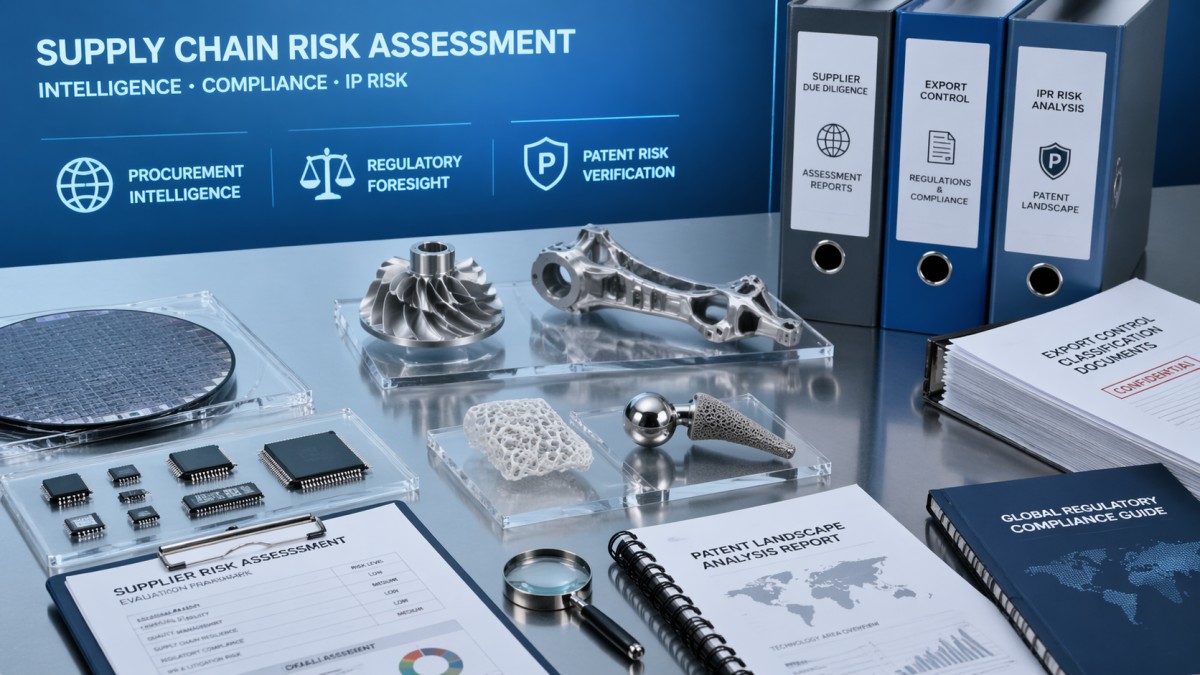
A supplier file can appear complete when it contains the usual inputs: specification sheets, declared standards, lead times, quality statements, and pricing terms. In practice, that level of completeness is often administrative rather than decision-grade. For sectors involving ALD precursors, multi-sensory metrology, ultra-high purity gases, or nano-positioning systems, procurement decisions depend on second-order evidence, not only on front-page specifications.
The first blind spot is scope ambiguity. A document may state compliance with ISO, SEMI, or IEEE frameworks, but fail to define whether compliance applies to the full production line, a single batch process, or only one inspection method. In a high-risk sourcing event, a 2% ambiguity in process coverage can create far more damage than a 5% price variance.
The second blind spot is data aging. In fast-moving engineering categories, capability claims older than 12–24 months may no longer reflect current tooling, process drift, contamination controls, or subcontractor dependencies. A supplier may still look qualified on paper while having shifted production sites, altered source materials, or changed firmware versions in critical control systems.
The third blind spot is missing context between engineering performance and commercial risk. A component can meet nominal tolerance yet be exposed to export restrictions, licensing delays, or patent overlap in specific jurisdictions. Procurement intelligence fails when technical acceptance is treated as a substitute for cross-border commercial readiness.
Four signals that a supplier profile is only surface-complete
- Performance values are listed, but test conditions are missing, such as temperature range, media purity, vibration environment, or calibration interval.
- Certificates are current, but there is no traceable link between certification scope and the exact production cell or material batch used for the quoted part.
- Lead time is shown as 8–10 weeks, yet no distinction is made between prototype runs, pilot lots, and volume orders above 500 units.
- The supplier declares IP awareness, but no screening logic is provided for adjacent patents, process claims, or regional filing conflicts.
The practical implication is clear: apparent completeness can be more dangerous than obvious absence. Missing data usually triggers review. Misleading completeness often passes unchallenged into sourcing, qualification, and production planning. That is where hidden procurement risk accumulates.
The Three Critical Gaps: Regulatory Foresight, Export Control, and Patent Landscape
In zero-defect manufacturing, supplier assessment must include three layers that are frequently under-modeled in ordinary procurement workflows. These are regulatory foresight, export control exposure, and patent landscape risk. Each one can delay projects by 4–16 weeks, increase qualification costs, or force redesign after sourcing decisions appear settled.
Regulatory foresight matters because compliance is not static. Material handling rules, purity thresholds, restricted substance requirements, and traceability expectations can shift during the life of a capital project. A supplier that is compliant today may not be compliance-ready for a production launch 9 months later unless change monitoring is embedded in the intelligence process.
Export control exposure matters because even technically interchangeable parts may carry very different licensing burdens depending on end use, destination, or embedded technology. Precision motion systems, sensing modules, specialty coatings, and gas handling assemblies can become procurement bottlenecks if classification or re-export rules are unclear at bid stage.
Patent landscape risk matters because infringement problems often surface after engineering teams have invested in validation. Where process windows are narrow, replacing a component after a patent challenge can trigger repeat testing, software retuning, and supplier requalification. For some categories, one late-stage redesign can consume 2–3 quarters of project momentum.
How these gaps show up in real sourcing decisions
The table below shows how a supplier can look acceptable in standard onboarding while still creating strategic sourcing risk in advanced industrial applications.
The key lesson is that these three gaps do not sit outside procurement. They sit inside procurement quality. A sourcing process that ignores them may still deliver a signed contract, but it does not reliably deliver operational integrity.
Minimum review cadence for high-spec categories
- Pre-bid screening: 5–10 business days for compliance and trade exposure mapping.
- Technical qualification review: 2–6 weeks depending on contamination sensitivity, precision class, and audit depth.
- Pre-award legal and IP check: 1–3 weeks for freedom-to-operate concerns and jurisdiction review.
- Post-award monitoring: monthly for project-critical suppliers and quarterly for mature categories.
This staged model is especially useful for procurement teams handling cross-functional sourcing where engineering, compliance, and commercial objectives must converge before supplier approval becomes truly decision-ready.
What Verifiable Supplier Intelligence Looks Like in Ultra-Precision Sourcing
Verifiable supplier intelligence is not a larger folder of documents. It is an evidence system. For advanced industrial procurement, this means every important claim should be linked to a test condition, a standards reference, a revision date, a responsible party, and an intended application boundary. Without those anchors, the profile remains descriptive rather than actionable.
In the context of G-UPE’s industrial pillars, verification should connect material science, process capability, and market reality. For thin-film deposition inputs, buyers may need confirmation of precursor stability and contamination controls. For precision pneumatic systems, they may need response time windows, leak-rate assumptions, and compatibility with defined pressure bands such as 0.2–0.8 MPa.
For metrology and nano-positioning categories, the evidence chain should include calibration methods, environmental assumptions, drift behavior, and interface compatibility. A stage that achieves sub-micron repeatability in a clean, temperature-stable lab may perform differently in a production environment with thermal variation of 2–3°C and cycle loads that multiply daily usage beyond test conditions.
The objective is not to create paperwork for its own sake. The objective is to reduce uncertainty before it converts into downtime, scrap, delayed qualification, or contractual friction. Procurement intelligence becomes valuable when it helps teams decide what is proven, what is assumed, and what still needs validation.
Core verification dimensions for decision-grade supplier data
The following framework can help procurement and quality teams determine whether a supplier profile is ready for advanced sourcing decisions.
A strong supplier profile should not simply say the supplier can deliver. It should show under what conditions, with what evidence, within what risk envelope, and with what fallback options if assumptions change during the sourcing cycle.
Common verification questions procurement teams should ask
- Which data points are measured, and which are modeled or estimated?
- What is the last verified date for contamination, repeatability, or purity performance?
- How many production sites can manufacture the same approved configuration?
- What substitution path exists if a raw material, gas source, or motion controller becomes restricted?
These questions turn supplier evaluation from a passive review into an active risk-control process. That shift is essential when procurement decisions influence not only cost, but also qualification timing, yield stability, and regulatory defensibility.
A Practical Evaluation Model for Procurement, Quality, and Engineering Teams
A workable model for supplier intelligence should be cross-functional and repeatable. In most advanced B2B environments, five review dimensions are enough to identify 80% of avoidable supplier risk before contract award. Those dimensions are technical fit, compliance foresight, trade exposure, IP defensibility, and delivery resilience.
Technical fit should be validated by application-specific evidence. A quoted tolerance, flow stability figure, or purity level only matters when tied to actual operating conditions. Quality teams should confirm whether values reflect qualification tests, production averages, or best-case laboratory results. This distinction often determines whether incoming inspection needs to be tightened from standard sampling to enhanced lot review.
Compliance foresight should assess not just current status but likely change pressure over the next 12 months. Business evaluators and safety managers should look at material declarations, change notification commitments, and documentation refresh cycles. If a supplier updates critical compliance files only once per year, that may be too slow for regulated project launches.
Trade exposure and IP defensibility should be reviewed before final sourcing recommendations are issued to decision-makers. If a precision subsystem depends on one region, one export license path, or one contested patent cluster, procurement should score that exposure openly rather than hiding it inside general supplier notes.
Suggested 5-part scoring method
- Technical Evidence Quality: score 1–5 based on traceability, application relevance, and test transparency.
- Regulatory Readiness: score 1–5 based on update cadence, material visibility, and forward-looking compliance signals.
- Export Control Exposure: score 1–5 based on jurisdiction complexity, licensing uncertainty, and re-export sensitivity.
- Patent Landscape Risk: score 1–5 based on overlap likelihood, substitute options, and commercialization flexibility.
- Supply Continuity: score 1–5 based on capacity redundancy, critical sub-tier concentration, and lead-time volatility.
Teams can then define escalation rules. For example, any supplier with a score below 3 in two or more categories should move to enhanced review before award. Any supplier scoring 1 in export control or patent risk should trigger legal and compliance review regardless of price competitiveness.
Who should own each part of the review
Procurement should coordinate timeline, comparability, and supplier response discipline. Engineering should validate technical performance boundaries. Quality should verify traceability and auditability. Compliance or legal functions should review trade and IP concerns. Senior decision-makers should then evaluate the total risk-adjusted value, not only the quoted cost.
This ownership model reduces the chance that a “complete-looking” file moves forward because every function assumed another team had checked the hidden layers. In practice, that assumption gap is one of the most common reasons procurement intelligence underperforms.
How to Operationalize Reliable Supplier Intelligence in High-Stakes Projects
To operationalize reliable supplier intelligence, companies need more than one-off vendor screening. They need a living workflow that connects sourcing, technical validation, compliance monitoring, and market updates. This is particularly important in industries where a single component can affect system-level accuracy, sterility assurance, or long-term field reliability.
A practical implementation usually starts with category segmentation. Not every purchased item needs the same level of scrutiny. Teams can divide categories into at least 3 levels: standard, controlled, and mission-critical. Mission-critical categories may include ultra-high purity gases, precision valves, metrology subsystems, coatings tied to process yield, and nano-positioning stages affecting final accuracy.
For controlled and mission-critical categories, procurement intelligence should be refreshed on a defined schedule. A quarterly review may be enough for mature suppliers with stable routes and broad compliance coverage. A monthly review is often more appropriate where export control changes, geopolitical exposure, or patent activity can alter sourcing viability quickly.
The most effective systems also create decision logs. If a supplier is approved despite one known risk, the reason should be documented along with mitigation measures, fallback sources, and reassessment dates. This improves auditability and prevents institutional memory loss when teams change.
Recommended implementation workflow
- Map categories by criticality and define review depth for each tier within 2–4 weeks.
- Build a supplier evidence template covering technical, regulatory, export, IP, and continuity fields.
- Set refresh intervals by category, such as monthly for mission-critical and quarterly for controlled suppliers.
- Create escalation triggers for changes in certification scope, shipment route, patent disputes, or compliance status.
- Record decisions and mitigation actions so future sourcing rounds do not restart from zero.
Organizations using a structured model gain a clearer view of true supplier readiness. They also reduce expensive surprises after nomination, when design freeze, validation cost, and production commitments make change more difficult and more expensive.
FAQ for procurement and technical teams
How often should supplier intelligence be updated?
For low-risk categories, every 6–12 months may be acceptable. For high-precision, cross-border, or regulated categories, monthly or quarterly updates are safer. The correct cycle depends on technical volatility, trade sensitivity, and how costly late-stage supplier replacement would be.
What makes a supplier profile decision-grade rather than marketing-grade?
A decision-grade profile includes test conditions, standards references, revision dates, traceability paths, and known limitations. It also clarifies whether data comes from production performance, validation runs, or development-stage claims. Marketing-grade content usually omits those boundaries.
Which teams benefit most from deeper procurement intelligence?
Procurement teams improve supplier selection quality. Operators and technical users gain more stable performance expectations. Quality and safety leaders obtain stronger audit trails. Business evaluators and executives make better risk-adjusted decisions, especially when projects involve long qualification cycles or international delivery complexity.
Can smaller supplier bases still be managed safely?
Yes, if visibility is strong. When alternate sources are limited, verification quality becomes even more important. In those cases, documenting fallback plans, dual-region logistics, and material substitution pathways can be more valuable than simply expanding the approved vendor list.
When supplier data only looks complete, procurement intelligence becomes vulnerable at exactly the point where engineering, compliance, and commercial risk intersect. Reliable sourcing in ultra-precision environments requires a deeper evidence model: one that tests technical claims, tracks regulatory change, maps export control exposure, and interprets patent landscape risk before contracts lock in hidden liabilities.
For organizations operating across semiconductor manufacturing, aerospace components, biological implants, and other advanced industrial domains, disciplined intelligence can protect qualification schedules, improve supplier comparability, and support stronger zero-defect outcomes. Global Ultra-Precision Engineering is designed for that intersection of technical benchmarking and commercial foresight.
If your team is reviewing high-spec suppliers, preparing a strategic sourcing round, or rechecking mission-critical vendor data, now is the right time to strengthen the evidence behind every sourcing decision. Contact us to discuss your requirements, request a tailored intelligence framework, or explore deeper benchmarking and risk visibility for your supplier base.
Taglist:
- Ultra-Precision Engineering
- Thin-Film Deposition
- Precision Pneumatic
- Multi-Sensory Metrology
- Nano-Positioning
- ALD Precursors
- Material Science
- Technical Benchmarking
- Regulatory Foresight
- Procurement Intelligence
- Export Control
- Patent Landscape
- Industrial Integrity
- Multidisciplinary Engineering
- Semiconductor Manufacturing
- Biological Implants
- Aerospace Components
- Zero-Defect Manufacturing
Recent Articles
 2026.04.24Where Zero-Defect Manufacturing Breaks Down FirstZero-Defect Manufacturing breaks first in Semiconductor Manufacturing, Aerospace Components, and Biological Implants—learn how metrology, suppliers, and regulatory foresight expose hidden risk.
 2026.04.24Aerospace Components Fail More Often at the InterfaceAerospace Components fail most often at the interface—discover how Zero-Defect Manufacturing, Multidisciplinary Engineering, and Procurement Intelligence reduce risk across aerospace, semiconductor manufacturing, and biological implants.
 2026.04.24Biological Implants and the Coating Problem Few Specs CatchBiological Implants face hidden coating risks that standard specs miss. Explore Zero-Defect Manufacturing, Procurement Intelligence, and Regulatory Foresight for safer sourcing decisions.
 2026.04.24What Still Causes Drift in Semiconductor Manufacturing?Semiconductor Manufacturing drift still threatens Zero-Defect Manufacturing. Learn how Multidisciplinary Engineering, Procurement Intelligence, Export Control, and Regulatory Foresight uncover hidden risks.
 2026.04.24Multidisciplinary Engineering Looks Efficient Until Handoffs StartMultidisciplinary Engineering in Zero-Defect Manufacturing: see how Aerospace Components, Biological Implants, and Semiconductor Manufacturing reduce handoff risk with Procurement Intelligence and Regulatory Foresight.
 2026.04.24Industrial Integrity Issues Often Start Before the First RunZero-Defect Manufacturing starts before launch. Learn how Industrial Integrity in Aerospace Components, Biological Implants, and Semiconductor Manufacturing depends on smarter validation, Procurement Intelligence, and Regulatory Foresight.
 2026.04.24Patent Landscape Gaps That Distort Technology DecisionsPatent Landscape gaps can distort decisions in Semiconductor Manufacturing, Aerospace Components, and Biological Implants. Discover how Procurement Intelligence, Export Control, and Regulatory Foresight reduce risk.
 2026.04.24Export Control Rules Are Shifting Faster Than Product PlansExport Control trends are reshaping Zero-Defect Manufacturing across Semiconductor Manufacturing, Aerospace Components, and Biological Implants. Discover how Regulatory Foresight drives smarter sourcing.
 2026.04.24Procurement Intelligence Fails When Supplier Data Looks CompleteProcurement Intelligence breaks down when supplier data only looks complete. Learn how Regulatory Foresight, Export Control, and Patent Landscape checks protect Zero-Defect Manufacturing.
 2026.04.24Regulatory Foresight Is Becoming a Design Constraint in 2026Regulatory Foresight is reshaping Zero-Defect Manufacturing in Semiconductor Manufacturing, Aerospace Components, and Biological Implants—see how Export Control, Patent Landscape, and Procurement Intelligence reduce risk.








FILTER_CORE
REF_NO: 0042