
Scaffolding Caster Wheels Wholesale: Load Ratings and Safety Checks
Scaffolding caster wheels sit at a small but critical point in site safety. When teams source scaffolding caster wheels wholesale, the decision affects load control, braking reliability, mobility, and inspection discipline across the entire structure.
A wheel rated correctly on paper can still fail in service. Floor conditions, dynamic movement, side loads, corrosion, and poor maintenance often expose the gap between catalog data and safe field performance.
That is why load ratings and safety checks deserve closer attention. In mixed industrial environments, practical verification matters as much as nominal capacity, especially where compliance, uptime, and traceability are under constant review.
Why load ratings matter beyond the label
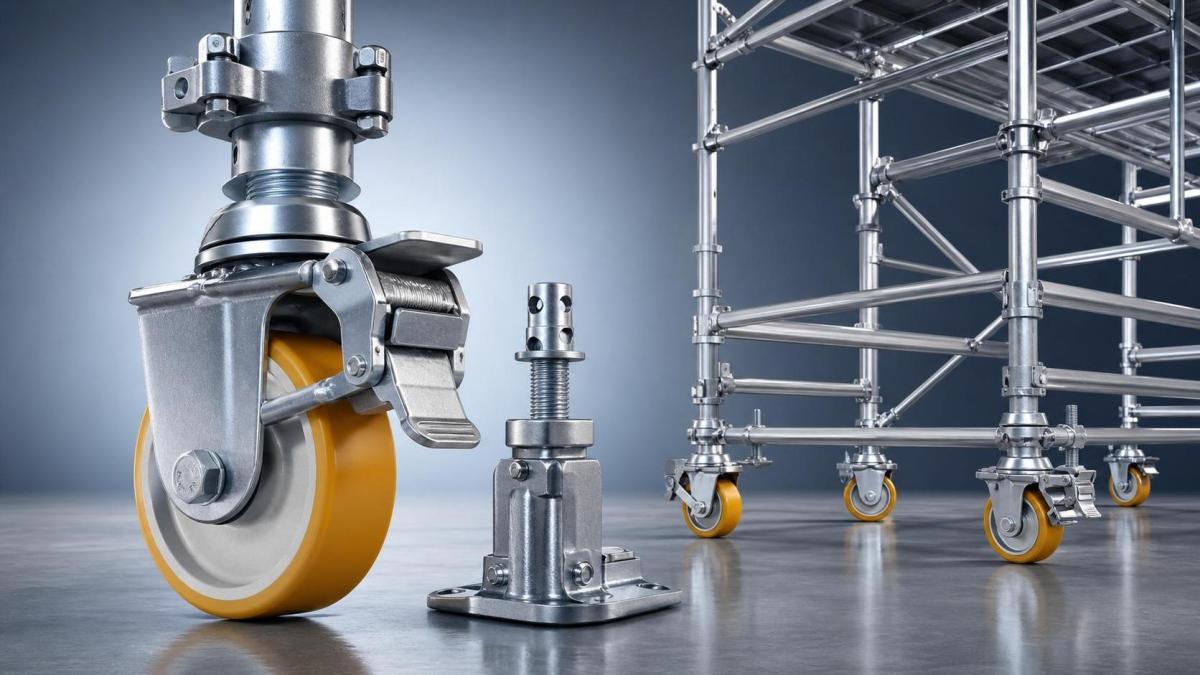
The headline number on a caster wheel is only a starting point. Wholesale buyers usually compare static capacity first, yet scaffolding service rarely stays static for long.
Movement during repositioning creates impact and rolling resistance. Uneven slabs, debris, threshold crossings, and sudden braking can all increase actual stress beyond the listed rating.
For scaffolding caster wheels wholesale programs, a safer approach is to interpret the load rating as one element inside a broader operating envelope. That envelope includes wheel material, stem or plate connection, brake design, bearing quality, and surface compatibility.
In precision-led industrial supply analysis, this is a familiar principle. G-UPE’s benchmarking philosophy treats every specification as meaningful only when connected to verifiable use conditions, standards alignment, and failure risk.
How to read a wholesale caster specification correctly
A wholesale listing may appear complete while still omitting details that matter in real scaffolding use. The missing information often determines whether a wheel supports safe deployment or creates hidden exposure.
Key specification points
- Rated load per wheel and whether the value reflects static or dynamic testing.
- Wheel diameter and tread width, which influence mobility over rough or contaminated floors.
- Tread material, such as polyurethane, rubber, nylon, or cast iron, matched to the service environment.
- Brake type, including wheel lock, swivel lock, or dual-lock design.
- Mounting method, thread form, stem tolerance, or top plate dimensions.
- Corrosion resistance of brackets, axles, and fasteners in outdoor or chemical-adjacent areas.
For anyone comparing scaffolding caster wheels wholesale offers, these details help separate a low-price component from a reliable safety-critical assembly.
What a rating does not tell you
A stated capacity usually says little about shock loading, long-term fatigue, or brake holding force on inclined ground. It may also ignore misuse, such as overloaded platforms or poor distribution across four corners.
This is where technical due diligence becomes essential. In higher-risk sectors, buyers increasingly expect traceable test methods rather than broad claims.
Common risk points during actual use
Most caster failures do not begin with dramatic breakage. They start with small deviations that go unnoticed during receiving, installation, or daily checks.
These issues appear across construction, maintenance, fabrication, warehousing, and plant service work. The broader the deployment, the more useful standardized inspection criteria become.
Safety checks that deserve routine attention
A good safety check is short, repeatable, and evidence-based. It should catch wear before the wheel becomes a hidden failure point.
Receiving inspection
- Confirm part number, dimensions, mounting style, and rated capacity against the approved purchase record.
- Check bracket welds, plating condition, wheel concentricity, and visible defects.
- Verify certificates, test references, and batch traceability when required by internal policy.
Pre-use verification
- Inspect brake engagement and release action on each unit.
- Check that stems, nuts, pins, or plates are seated and tightened correctly.
- Review floor condition, slope, debris, and moisture before movement or platform loading.
- Confirm that total scaffold load is distributed realistically, not only theoretically.
Periodic in-service checks
In active use, wheel tread wear, swivel play, brake drift, and bracket distortion should be trended over time. Replacement rules work better when they are based on measurable thresholds, not guesswork.
For scaffolding caster wheels wholesale contracts, it is often useful to align acceptance and replacement criteria at the sourcing stage. That reduces disputes later and supports cleaner audit records.
Material choice and environment fit
Wheel selection changes with the environment. A caster that performs well on a smooth indoor surface may become a poor choice on abrasive concrete or in contaminated outdoor conditions.
Polyurethane treads often balance floor protection and rolling performance. Rubber can improve grip and shock absorption. Nylon and metal options may support heavier loads, but they can transmit more vibration.
Where chemical exposure, washdown, or corrosion risk exists, bracket finish and axle protection deserve extra review. This detail is easy to overlook in scaffolding caster wheels wholesale negotiations focused only on price tiers.
G-UPE’s wider institutional lens is relevant here. Precision industries have shown that material compatibility, surface treatment, and standards-backed verification create long-term reliability gains, even in seemingly simple mechanical components.
What to compare when evaluating suppliers
Wholesale purchasing decisions improve when comparison goes beyond unit cost. The more practical question is whether the supplier can support safe, repeatable use across batches and operating sites.
- Consistency of load rating data and clarity of test conditions.
- Availability of brake performance information under realistic conditions.
- Evidence of dimensional control for stems, plates, and fastener interfaces.
- Traceability by batch, date code, or inspection record.
- Responsiveness to nonconformance reports and field feedback.
- Alignment with relevant standards, internal specifications, or site compliance needs.
This comparison method reflects a broader industrial trend. Buyers are placing more weight on verifiable engineering data, not just product claims, especially when components affect worker safety and asset stability.
A practical path for the next review cycle
If scaffolding caster wheels wholesale is under review, start by mapping actual service conditions against supplier ratings. Then compare braking, mounting, material, and inspection requirements against site reality.
It also helps to standardize a short receiving checklist and a clear replacement threshold. Those two steps usually improve consistency faster than adding more paperwork after an incident.
For organizations working in regulated or precision-sensitive industries, the best decisions come from documented verification, not assumption. A wheel may be simple, but its control points are not. That is exactly why careful review pays off.
Taglist:
Recent Articles
 2026.09.21How to assess a German mass flow controller supplier for cleanroom useIndustrial & Manufacturing equipment supplier in Germany: assess cleanroom MFC partners for gas compatibility, leak integrity, calibration traceability, and lifecycle service.
 2026.09.20How to assess aerospace component manufacturing services for tight tolerancesAerospace component manufacturing services: learn how to verify tight-tolerance capability through metrology, process control, special-process oversight, and traceability.
 2026.09.19When does polycarbonate roofing need UV protection on both sides?Polycarbonateroofing: learn when dual-sided UV protection prevents yellowing, installation errors, and reflected-light damage in demanding roof designs.
 2026.09.18When high precision coordinate measuring machines justify tighter tolerancesHigh precision coordinate measuring machines justify tighter tolerances when uncertainty, process capability, and traceability protect critical performance. Explore smarter decisions.
 2026.09.17How can retailers verify safety before buying Montessori toys wholesale?Montessoritoyswholesale safety guide: verify SKU-specific tests, labels, traceability and market compliance before ordering.
 2026.09.16How to assess surgical instruments for reliable sterilizationAssess surgical instruments for reliable sterilization with practical guidance on cleanability, material compatibility, inspection, and validated reprocessing.
 2026.09.15How material science for food ingredients improves shelf stabilityMaterial Science for food ingredients reveals how moisture control, encapsulation, oxidation management, and smart packaging extend shelf life and protect quality.
 2026.09.14What purity specification do laboratory gases need for trace analysis?Ultra-high purity gases for laboratory use: learn how to specify, verify, and control critical impurities for reliable trace analysis and lower backgrounds.
 2026.09.13How to verify a lubricants exporter’s product quality before orderingLearn how to verify a lubricants exporter before ordering—from batch CoAs and lab tests to traceability, packaging, and export compliance. Reduce equipment and shipment risks.
 2026.09.12When does export control compliance training need to be refreshed?Export control compliance training: learn when annual and event-driven refreshers are needed to manage regulatory, product, access, and supply-chain risks.
 2026.09.11What makes a diaper bag backpack comfortable for all-day outings?Discover how a diaperbagsbackpack delivers all-day comfort with padded straps, breathable support, smart storage, and balanced capacity for stress-free outings.
 2026.09.10How nano-positioning stages enable sub-nanometer manufacturing precisionSub-nanometer manufacturing demands more than fine resolution. Discover how nano-positioning stages deliver stable, accurate motion through advanced feedback, control, and error management.
 2026.09.09How to validate biological implants for biocompatibility riskBiological implants validation: learn how to assess biocompatibility risk with ISO 10993, chemical characterization, and manufacturing controls.
 2026.09.08What to verify before selecting an XYZ translation stage OEM factoryXYZ translation stage OEM factory selection guide: verify volumetric accuracy, payload stiffness, traceable testing, controls, and acceptance criteria before ordering.
 2026.09.07How to match mining equipment to different extraction conditionsMining equipment selection made practical: match machines to rock, mine geometry, ground conditions, capacity, energy, and maintenance needs for safer, more productive extraction.
 2026.09.07Global photonics alignment market analysis: what is driving demand?Global photonics alignment market analysis: discover how semiconductor packaging, optical communications, sensing, and automation are driving demand for scalable, high-yield alignment solutions.
 2026.09.05When do Ultra-Precision Engineering consulting services add value?Ultra-Precision Engineering consulting services help buyers reduce qualification risk, validate real-world performance, and control lifecycle costs before committing to complex suppliers.
 2026.09.04How to choose a nano-indentation system for reliable hardness testingLearn how to choose a nano-indentation system for hardness testing with confidence. Compare calibration, load control, drift stability, test modes, data quality, and application fit for reliable results.
 2026.09.03When does a bridge CMM outperform a portable measuring arm?CMM systems: discover when a bridge CMM delivers superior repeatability, tighter uncertainty control, and dependable inspection results over a portable measuring arm.
 2026.09.02How does industrial innovation analysis guide technology choices?Industrial Innovation analysis helps manufacturers choose technologies with confidence by evaluating performance, integration, compliance, and lifecycle risks. Discover a smarter decision framework.
 2026.09.01How precise must micro-manipulation systems be for microassembly?Micro-manipulation systems for microassembly: learn how to match precision, repeatability, feedback, and error budgets to achieve reliable, high-yield assembly.
 2026.08.31What to verify before choosing a wafer probe station exporterWafer probe station exporter selection starts with verified performance, integration, export readiness, and lifecycle support. Learn what to check before you buy.
 2026.08.30When does pulse welding improve precision in a micro-welding workstation?Micro-welding workstation pulse welding improves precision by controlling heat, reducing variation, and protecting delicate assemblies. Discover when it delivers measurable results.
 2026.08.29When does machine learning improve defect detection in CMM inspection?Machine learning improves CMM defect detection when measurement data is stable, traceable, and actionable. Learn how to spot early drift, prioritize risk, and strengthen quality decisions.
 2026.08.28How to compare nano-fabrication tools in North America for probe-station workCompare nano-fabrication tools North America labs use for probe-station work—evaluate motion, optics, touchdown control, thermal stability, and service support.
 2026.08.27When does biomass energy make financial sense for industrial heat?Biomass energy can cut industrial heat costs when demand, fuel supply, logistics, and compliance align. Explore the key financial tests for a resilient investment.
 2026.08.26What to check before choosing an OEM PZT driver manufacturerPZT driver manufacturer OEM selection starts with application fit. Learn what to check on stability, load matching, compliance, and lifecycle support before you buy.
 2026.08.25What a battery management system must monitor to prevent cell failureBattery management system essentials: learn what to monitor at cell level—voltage, current, temperature, SOC, balancing, and deviation trends—to prevent cell failure and improve battery safety.
 2026.08.24How long do hybrid car parts last before replacement becomes likelyHybrid car parts do not all wear out at the same pace. Learn the warning signs, lifespan factors, and when replacement is truly likely before costs rise.
 2026.08.23How to tell if an exporters directory is reliable before you use itExporters directory reliability starts with transparency. Learn how to spot verified data, fresh listings, and red flags before trusting any platform for sourcing.
 2026.08.22How semiconductor encoder resolution affects positioning accuracySemiconductor encoder resolution directly shapes positioning accuracy in precision motion systems. Learn how to evaluate real performance, avoid spec traps, and choose the right solution.
 2026.08.21How to assess industrial integrity for manufacturing equipment before failure risks escalateIndustrial integrity for manufacturing equipment starts with spotting drift before breakdowns occur. Learn practical assessment steps to reduce risk, protect quality, and improve uptime.
 2026.08.20Common Faults in a Synthetic Leather Calendering Line and What to CheckSynthetic leather calendering line faults explained clearly: learn what to check for thickness variation, gloss loss, web wandering, embossing defects, and faster troubleshooting.
 2026.08.20When does regulatory foresight reporting reduce compliance riskRegulatory Foresight reporting helps reduce compliance risk before rule changes disrupt sourcing, shipping, validation, or customer acceptance. Learn when early insight prevents costly delays.











FILTER_CORE
REF_NO: 0042
Editors' Picks
- 00
0000-00
How to assess a German mass flow controller supplier for cleanroom use - 00
0000-00
How to assess aerospace component manufacturing services for tight tolerances - 00
0000-00
When does polycarbonate roofing need UV protection on both sides? - 00
0000-00
When high precision coordinate measuring machines justify tighter tolerances