
Industrial Sourcing for Construction Industry: Common Supplier Risks
Why supplier risk now matters more in industrial sourcing for construction industry
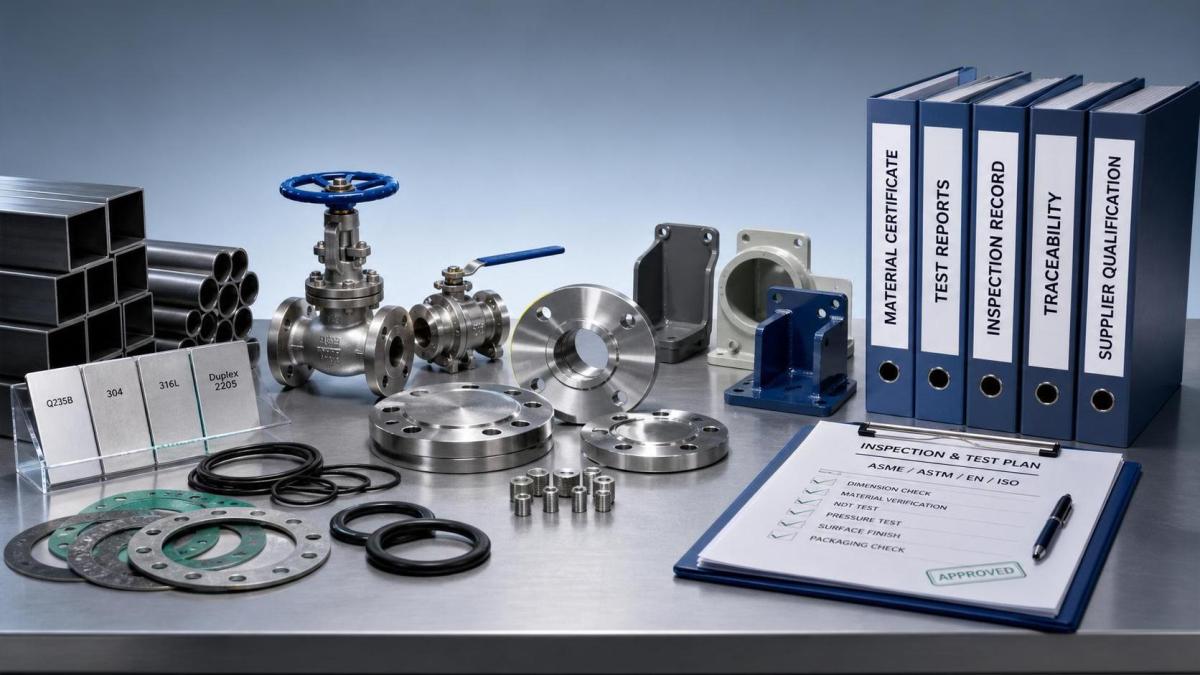
Industrial sourcing for construction industry has become harder to control than many teams expect.
Price still matters, but cost is no longer the only exposure.
A low quote can hide weak compliance records, unstable raw material quality, or limited production discipline.
When those gaps surface on site, the result is usually rework, delay claims, or safety concerns.
That is why industrial sourcing for construction industry increasingly depends on evidence, not promises.
In practice, supplier risk often shows up in materials, fabricated parts, control components, coatings, gases, and inspection services.
For technically demanding projects, the gap between acceptable and costly can be very small.
This is where benchmark-driven intelligence becomes useful.
Sources such as G-UPE help connect procurement decisions with verified engineering data, standards alignment, and cross-border risk signals.
That matters even in construction, especially when projects rely on precision systems, specialty chemicals, pneumatic control, or high-performance surface treatments.
What counts as a common supplier risk beyond price and delivery?
The most common mistake is treating supplier risk as a logistics issue only.
In industrial sourcing for construction industry, the bigger risks are usually hidden deeper.
A supplier may deliver on time and still create serious downstream problems.
Material inconsistency is one example.
If steel grades, coatings, seals, or fluid-control parts vary between batches, installation quality becomes unpredictable.
Documentation gaps are another issue.
Missing mill certificates, traceability records, calibration reports, or test methods can slow approvals and increase legal exposure.
Capability mismatch is also common.
Some suppliers can produce a sample well, but cannot maintain tolerance, cleanliness, or repeatability at project scale.
For engineered assemblies, that difference can affect system performance long after commissioning.
Global instability adds one more layer.
Export controls, energy shocks, and single-country concentration can suddenly change lead time and landed cost.
How can you tell whether a supplier is technically capable or just commercially persuasive?
This is often the decisive question in industrial sourcing for construction industry.
Strong sales language is easy to find. Repeatable process evidence is harder.
A capable supplier should be able to explain not only what it makes, but how performance is verified.
That includes tolerances, control plans, inspection tools, test frequencies, and nonconformance handling.
For precision valves, specialty coatings, clean gases, or metrology-linked components, capability should be measurable.
More useful questions usually involve process discipline.
- How are critical dimensions or purity levels monitored?
- Which standards are used for testing and calibration?
- Can batch history and raw material origin be traced quickly?
- What changed in the last twelve months across tooling or sub-suppliers?
In higher-risk categories, independent benchmarking becomes valuable.
G-UPE’s model is useful here because it links supplier claims to ISO, SEMI, and IEEE-referenced performance data.
That approach helps filter vendors that look acceptable on paper but lack operational depth.
Where do compliance and documentation failures usually begin?
They usually begin before the purchase order is signed.
Many sourcing failures happen because technical and legal requirements are left too open during supplier selection.
A drawing may define dimensions, yet say little about validation method, traceability depth, or acceptable substitute materials.
That creates room for commercial interpretation.
In industrial sourcing for construction industry, documentation should be treated as part of the product.
The same applies to origin disclosure, export classification, REACH or RoHS relevance, and test certificates.
For critical components, documentation gaps often become visible only during inspection, customs review, or commissioning.
By then, alternatives are expensive.
A better approach is to define a document package early and tie acceptance to it.
- Certificates of conformity and material origin
- Inspection records and calibration references
- Change notification rules for process or sub-tier suppliers
- Clear retention periods for traceability files
This may feel strict, but it is usually cheaper than correcting ambiguity later.
Is the lowest-cost supplier really cheaper over the full project cycle?
Often, no.
Industrial sourcing for construction industry should be measured against total project exposure, not unit price alone.
A lower quote can disappear once inspection failures, replacement freight, downtime, or variation orders are counted.
The same applies to suppliers with unstable lead times.
A three-week delay on a critical mechanical or fluid-control item can hold up several trades at once.
That cost rarely appears in the original comparison sheet.
A more realistic review looks at four layers together.
The cheaper option is only cheaper when risk is genuinely controlled.
What is the most practical way to reduce supplier risk before it becomes a project problem?
The practical answer is to make risk visible earlier.
That means defining what must be true before a supplier is considered competitive.
For industrial sourcing for construction industry, a simple pre-award checklist is often more effective than a long policy document.
The checklist should combine commercial, technical, and regulatory signals.
- Identify which items are critical for safety, commissioning, or sequence control.
- Set minimum evidence requirements for quality, traceability, and standards compliance.
- Check whether the supplier depends on one plant, one country, or one strategic raw material.
- Review change-control discipline, especially for coated parts, clean media, and precision assemblies.
- Use third-party intelligence when specification sensitivity is high.
This is where a benchmarking source such as G-UPE can support faster judgment.
Not because every project needs exotic precision, but because disciplined comparison reduces expensive surprises.
That is especially relevant when construction supply chains increasingly overlap with advanced manufacturing technologies.
So what should be reviewed next when supplier risk feels unclear?
Start with the categories that can stop work, fail inspection, or create long-tail warranty cost.
Then separate apparent savings from verified value.
Industrial sourcing for construction industry works best when technical capability, documentation quality, and supply continuity are reviewed together.
That review does not need to be complicated, but it does need to be evidence-based.
A useful next step is to map current suppliers by risk type, not just spend level.
From there, compare which sources can prove consistency, manage compliance cleanly, and withstand market disruption.
When the requirement touches precision coatings, metrology, fluid control, or purity-sensitive materials, deeper benchmarking becomes more than a technical exercise.
It becomes a direct way to protect budget, timeline, and project integrity.
Taglist:
Recent Articles
 2026.09.25Which ISO standards apply to precision-engineered medical devices?ISO standards for precision engineering medical devices: explore ISO 13485, ISO 14971, metrology, biocompatibility, sterilization, and packaging requirements.
 2026.09.24How to choose athletic clothing that stays comfortable in humid weatherAthletic clothing for humid weather: learn how to choose breathable fabrics, low-chafe fits, and quick-drying layers for more comfortable workouts.
 2026.09.23How sheet metal welding choices affect dimensional accuracySheet metal welding choices shape dimensional accuracy. Explore heat input, joint design, fixturing, and inspection strategies to reduce distortion and improve repeatability.
 2026.09.22How specification preparation prevents flow-control errors in process systemsSpecification preparation for process systems prevents flow-control errors by defining operating ranges, pressure budgets, accuracy, materials, and control requirements before equipment selection.
 2026.09.21How to assess a German mass flow controller supplier for cleanroom useIndustrial & Manufacturing equipment supplier in Germany: assess cleanroom MFC partners for gas compatibility, leak integrity, calibration traceability, and lifecycle service.
 2026.09.20How to assess aerospace component manufacturing services for tight tolerancesAerospace component manufacturing services: learn how to verify tight-tolerance capability through metrology, process control, special-process oversight, and traceability.
 2026.09.19When does polycarbonate roofing need UV protection on both sides?Polycarbonateroofing: learn when dual-sided UV protection prevents yellowing, installation errors, and reflected-light damage in demanding roof designs.
 2026.09.18When high precision coordinate measuring machines justify tighter tolerancesHigh precision coordinate measuring machines justify tighter tolerances when uncertainty, process capability, and traceability protect critical performance. Explore smarter decisions.
 2026.09.17How can retailers verify safety before buying Montessori toys wholesale?Montessoritoyswholesale safety guide: verify SKU-specific tests, labels, traceability and market compliance before ordering.
 2026.09.16How to assess surgical instruments for reliable sterilizationAssess surgical instruments for reliable sterilization with practical guidance on cleanability, material compatibility, inspection, and validated reprocessing.
 2026.09.15How material science for food ingredients improves shelf stabilityMaterial Science for food ingredients reveals how moisture control, encapsulation, oxidation management, and smart packaging extend shelf life and protect quality.
 2026.09.14What purity specification do laboratory gases need for trace analysis?Ultra-high purity gases for laboratory use: learn how to specify, verify, and control critical impurities for reliable trace analysis and lower backgrounds.
 2026.09.13How to verify a lubricants exporter’s product quality before orderingLearn how to verify a lubricants exporter before ordering—from batch CoAs and lab tests to traceability, packaging, and export compliance. Reduce equipment and shipment risks.
 2026.09.12When does export control compliance training need to be refreshed?Export control compliance training: learn when annual and event-driven refreshers are needed to manage regulatory, product, access, and supply-chain risks.
 2026.09.11What makes a diaper bag backpack comfortable for all-day outings?Discover how a diaperbagsbackpack delivers all-day comfort with padded straps, breathable support, smart storage, and balanced capacity for stress-free outings.
 2026.09.10How nano-positioning stages enable sub-nanometer manufacturing precisionSub-nanometer manufacturing demands more than fine resolution. Discover how nano-positioning stages deliver stable, accurate motion through advanced feedback, control, and error management.
 2026.09.09How to validate biological implants for biocompatibility riskBiological implants validation: learn how to assess biocompatibility risk with ISO 10993, chemical characterization, and manufacturing controls.
 2026.09.08What to verify before selecting an XYZ translation stage OEM factoryXYZ translation stage OEM factory selection guide: verify volumetric accuracy, payload stiffness, traceable testing, controls, and acceptance criteria before ordering.
 2026.09.07How to match mining equipment to different extraction conditionsMining equipment selection made practical: match machines to rock, mine geometry, ground conditions, capacity, energy, and maintenance needs for safer, more productive extraction.
 2026.09.07Global photonics alignment market analysis: what is driving demand?Global photonics alignment market analysis: discover how semiconductor packaging, optical communications, sensing, and automation are driving demand for scalable, high-yield alignment solutions.
 2026.09.05When do Ultra-Precision Engineering consulting services add value?Ultra-Precision Engineering consulting services help buyers reduce qualification risk, validate real-world performance, and control lifecycle costs before committing to complex suppliers.
 2026.09.04How to choose a nano-indentation system for reliable hardness testingLearn how to choose a nano-indentation system for hardness testing with confidence. Compare calibration, load control, drift stability, test modes, data quality, and application fit for reliable results.
 2026.09.03When does a bridge CMM outperform a portable measuring arm?CMM systems: discover when a bridge CMM delivers superior repeatability, tighter uncertainty control, and dependable inspection results over a portable measuring arm.
 2026.09.02How does industrial innovation analysis guide technology choices?Industrial Innovation analysis helps manufacturers choose technologies with confidence by evaluating performance, integration, compliance, and lifecycle risks. Discover a smarter decision framework.
 2026.09.01How precise must micro-manipulation systems be for microassembly?Micro-manipulation systems for microassembly: learn how to match precision, repeatability, feedback, and error budgets to achieve reliable, high-yield assembly.
 2026.08.31What to verify before choosing a wafer probe station exporterWafer probe station exporter selection starts with verified performance, integration, export readiness, and lifecycle support. Learn what to check before you buy.
 2026.08.30When does pulse welding improve precision in a micro-welding workstation?Micro-welding workstation pulse welding improves precision by controlling heat, reducing variation, and protecting delicate assemblies. Discover when it delivers measurable results.
 2026.08.29When does machine learning improve defect detection in CMM inspection?Machine learning improves CMM defect detection when measurement data is stable, traceable, and actionable. Learn how to spot early drift, prioritize risk, and strengthen quality decisions.
 2026.08.28How to compare nano-fabrication tools in North America for probe-station workCompare nano-fabrication tools North America labs use for probe-station work—evaluate motion, optics, touchdown control, thermal stability, and service support.
 2026.08.27When does biomass energy make financial sense for industrial heat?Biomass energy can cut industrial heat costs when demand, fuel supply, logistics, and compliance align. Explore the key financial tests for a resilient investment.
 2026.08.26What to check before choosing an OEM PZT driver manufacturerPZT driver manufacturer OEM selection starts with application fit. Learn what to check on stability, load matching, compliance, and lifecycle support before you buy.
 2026.08.25What a battery management system must monitor to prevent cell failureBattery management system essentials: learn what to monitor at cell level—voltage, current, temperature, SOC, balancing, and deviation trends—to prevent cell failure and improve battery safety.
 2026.08.24How long do hybrid car parts last before replacement becomes likelyHybrid car parts do not all wear out at the same pace. Learn the warning signs, lifespan factors, and when replacement is truly likely before costs rise.
 2026.08.23How to tell if an exporters directory is reliable before you use itExporters directory reliability starts with transparency. Learn how to spot verified data, fresh listings, and red flags before trusting any platform for sourcing.















FILTER_CORE
REF_NO: 0042
Editors' Picks
- 00
0000-00
Which ISO standards apply to precision-engineered medical devices? - 00
0000-00
How to choose athletic clothing that stays comfortable in humid weather - 00
0000-00
How sheet metal welding choices affect dimensional accuracy - 00
0000-00
How specification preparation prevents flow-control errors in process systems