
How to Read Positioning Encoder Resolution Data Without Misjudging Accuracy
In motion-control and metrology systems, positioning encoder resolution data is often mistaken for a direct measure of real-world accuracy. For technical evaluators, this confusion can distort vendor comparisons, risk tolerance, and system selection. This article explains how to interpret resolution data correctly, distinguish it from accuracy and repeatability, and make more reliable engineering judgments in precision applications.
Why Scenario Differences Matter More Than a Single Number
For technical assessment teams, positioning encoder resolution data is useful only when it is read in context. A nanometer-level resolution claim may look impressive in a datasheet, yet the practical value depends on the load, travel length, thermal drift, servo tuning, installation geometry, signal interpolation, and operating environment. In other words, the same encoder specification can be highly relevant in one application and almost meaningless in another.
This matters across the broader precision industry, from semiconductor positioning modules and optics alignment systems to CMM platforms, biomedical assembly, and aerospace inspection fixtures. Buyers comparing suppliers often overvalue the smallest displayed increment while undervaluing system-level error sources. That creates a classic procurement risk: selecting a platform with excellent positioning encoder resolution data but insufficient accuracy under real operating conditions.
A more disciplined reading starts with a simple question: what decision must the machine support in the target application? If the process requires repeatable approach to a target location, repeatability may matter more than absolute accuracy. If the process depends on traceable coordinate truth over a long axis, scale accuracy, environmental compensation, and calibration stability become more important than nominal resolution.
First Principles: Resolution Is Not Accuracy
Before looking at applications, evaluators should separate four terms that vendors sometimes blur together. Resolution is the smallest position increment the feedback system can detect or report. Accuracy is the closeness of the reported or achieved position to the true position. Repeatability is the ability to return to the same point consistently. Precision is often used loosely, but in evaluation work it is better to break it into measurable items rather than treat it as a marketing term.
Positioning encoder resolution data can improve control granularity, but it cannot cancel mechanical straightness error, Abbe offset, backlash, scale contamination, thermal expansion, or servo instability. A stage can report 1 nm increments and still miss the true target by microns if the rest of the system is not engineered to support that level of performance.
A practical interpretation rule is this: resolution tells you what the system can count, not automatically what the machine can achieve. For technical evaluators, that distinction should shape every comparison matrix, factory acceptance test, and vendor Q&A.
Typical Application Scenarios and What to Check First
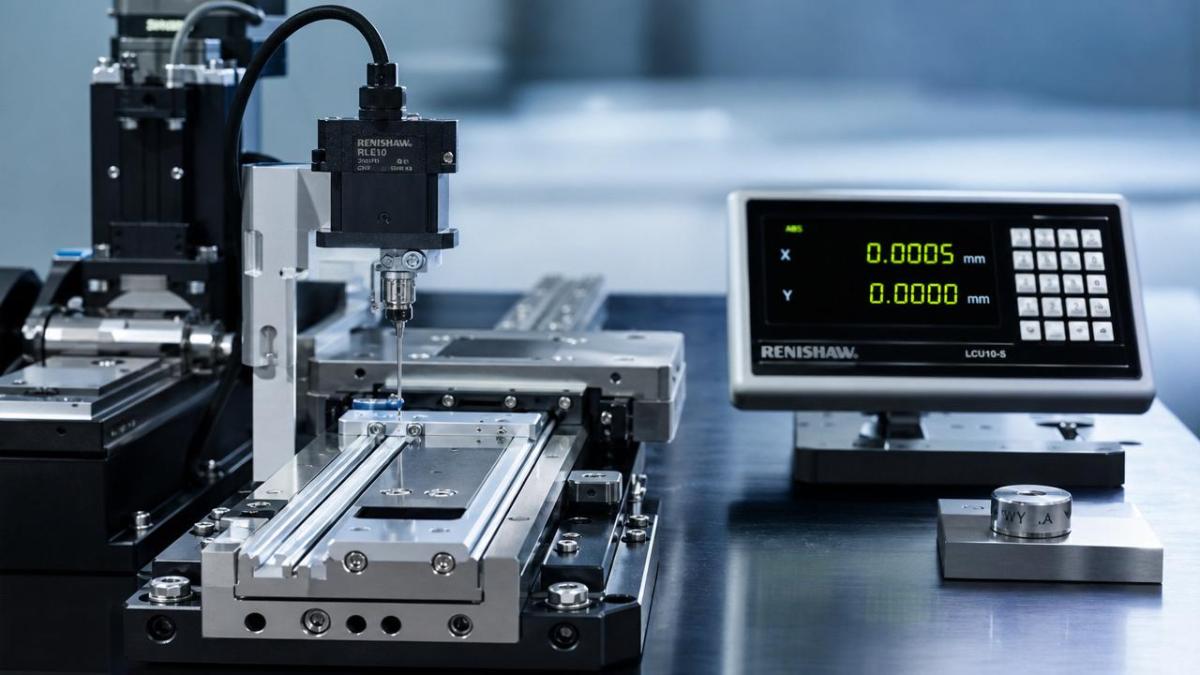
Different business scenarios place different weight on positioning encoder resolution data. The table below helps evaluators connect the number on the datasheet to the decision logic required in actual projects.
This scenario view prevents a common mistake: ranking products by the finest encoder number without testing whether that number affects process capability, yield, or inspection confidence.
Scenario 1: Semiconductor and Nano-Positioning Systems
In ultra-precision motion platforms, positioning encoder resolution data is often extremely fine because the process requires smooth interpolation and precise servo feedback. Here, resolution can be genuinely important, especially for short-stroke stages, beam steering platforms, and alignment modules. However, even in this high-end environment, evaluators should avoid reading the value in isolation.
The real question is whether the encoder signal quality supports stable control under acceleration, settling, and external disturbance. Fine interpolated resolution may look ideal, but interpolation error, electronic noise, and mounting stress can degrade the usable position information. Evaluators should ask for dynamic error plots, settling time at defined move distances, bidirectional repeatability, and error under thermal soak. If a supplier presents only positioning encoder resolution data and no motion test evidence, the technical case is incomplete.
Scenario 2: CMM, Optical Measurement, and Traceable Metrology
For metrology systems, especially CMM and multisensory platforms, users often assume finer readout equals better measurement truth. This is one of the most expensive misjudgments in capital equipment selection. In metrology, the key output is not simply motion resolution but reliable coordinate accuracy across the measurement volume.
In this scenario, positioning encoder resolution data should be treated as a supporting parameter. More decisive factors include scale accuracy, geometry compensation, probe uncertainty, machine structure, and environmental control. A very fine encoder cannot compensate for volumetric errors caused by axis squareness drift or thermal gradients. Technical evaluators should therefore request uncertainty statements, compensation strategy, calibration interval, and compliance with relevant ISO practices. If the machine will inspect tight-tolerance aerospace or medical components, confidence in traceability matters far more than the smallest displayed increment.
Scenario 3: Micro-Assembly, Life Sciences, and Delicate Handling
In micro-assembly and biomedical device production, the best system is not always the one with the finest positioning encoder resolution data. Many tasks involve sensitive contact forces, fragile substrates, compliant fixtures, or vision-guided corrections. In such cases, process success depends on repeatable behavior under real payload and contact conditions.
For example, placing a micro-component onto an adhesive, a flexible lead, or a biologically compatible surface may require consistent approach behavior rather than perfect absolute position. Evaluators should focus on repeatability under load, axis coupling, control smoothness at low speed, and recovery from disturbance. If encoder resolution is excellent but the stage exhibits stick-slip, vibration, or thermal drift during production hours, process capability may still be poor.
Scenario 4: Long-Travel Industrial Positioning and Retrofit Projects
In larger automation systems, gantries, material handling axes, or retrofit machine upgrades, positioning encoder resolution data may be given prominent marketing attention even though the application does not require extreme resolution. For these projects, technical evaluators should ask whether the process is limited by feedback granularity at all. In many cases, stiffness, contamination resistance, cable management, PLC integration, and maintainability are more important.
A retrofit project can easily overspecify the encoder and still underperform because the machine frame, guideway wear, or thermal environment sets the true limit. Here, the most valuable analysis is a tolerance chain review: what portion of process error is actually attributable to encoder feedback, and what portion comes from mechanics, fixturing, or process variability? If encoder contribution is already small, buying dramatically finer resolution may add cost without measurable business gain.
How Different Evaluators Should Read the Same Data
Not every stakeholder uses positioning encoder resolution data for the same purpose. A useful internal review distinguishes roles and decision criteria.
Common Misjudgments When Reading Positioning Encoder Resolution Data
Several errors appear repeatedly in vendor comparison work. The first is assuming displayed resolution equals closed-loop positioning accuracy. The second is comparing interpolated encoder resolution from one supplier against native scale performance from another without understanding the signal chain. The third is ignoring the difference between short-range repeatability and full-stroke accuracy.
Another common oversight is failing to match test conditions. Positioning encoder resolution data measured in a controlled lab at constant temperature may not represent real factory performance near heat sources, vibration, or contamination. Technical evaluators should request conditions of measurement, not just the headline figure. Finally, many teams forget that software filtering can make readout appear cleaner while introducing latency or masking dynamic behavior. A smooth number is not always a truthful number.
A Practical Evaluation Checklist for Scenario Fit
To determine whether positioning encoder resolution data is actually decision-relevant in your project, use a short scenario-fit checklist. First, define whether your process is accuracy-driven, repeatability-driven, throughput-driven, or compliance-driven. Second, identify the true dominant error sources in the machine or measurement chain. Third, map encoder capability to the motion distance, speed, load, and environment used in production. Fourth, request proof in the form of calibrated tests, not only catalog values. Fifth, compare business impact: does finer resolution improve yield, reduce scrap, shorten cycle time, or improve acceptance confidence?
In high-value sectors covered by institutions such as G-UPE, this disciplined method is essential because procurement decisions increasingly cross boundaries between materials, fluids, metrology, and nano-positioning subsystems. Encoder data must be interpreted as part of a verifiable engineering ecosystem, not as a standalone badge of superiority.
FAQ for Technical Evaluators
Can two systems with identical positioning encoder resolution data perform very differently?
Yes. Mechanical design, servo tuning, thermal management, scale mounting, and environmental control can create major performance differences even when encoder resolution is the same.
When is encoder resolution especially important?
It matters most when control granularity directly affects process results, such as ultra-fine motion, low-speed smoothness, or dynamic positioning in high-end precision systems. Even then, it should be verified against system-level tests.
What is the safest vendor question to ask?
Ask how the published positioning encoder resolution data translates into verified accuracy, repeatability, and stability under your exact operating scenario.
Conclusion: Judge the Application, Not Just the Increment
The most reliable way to read positioning encoder resolution data is to treat it as one layer of evidence, not the final verdict. In semiconductor positioning, metrology, biomedical assembly, and industrial retrofit work, the right interpretation depends on scenario, error budget, and business objective. Technical evaluators who compare systems only by resolution risk overspecification, underperformance, or false confidence.
A stronger evaluation asks what the application truly needs, which errors dominate, and what validated tests prove fitness for use. If your team is reviewing high-precision motion or inspection platforms, align positioning encoder resolution data with actual process conditions, calibration evidence, and long-term operating stability before making a supplier decision.
Recent Articles
 2026.09.21How to assess a German mass flow controller supplier for cleanroom useIndustrial & Manufacturing equipment supplier in Germany: assess cleanroom MFC partners for gas compatibility, leak integrity, calibration traceability, and lifecycle service.
 2026.09.20How to assess aerospace component manufacturing services for tight tolerancesAerospace component manufacturing services: learn how to verify tight-tolerance capability through metrology, process control, special-process oversight, and traceability.
 2026.09.19When does polycarbonate roofing need UV protection on both sides?Polycarbonateroofing: learn when dual-sided UV protection prevents yellowing, installation errors, and reflected-light damage in demanding roof designs.
 2026.09.18When high precision coordinate measuring machines justify tighter tolerancesHigh precision coordinate measuring machines justify tighter tolerances when uncertainty, process capability, and traceability protect critical performance. Explore smarter decisions.
 2026.09.17How can retailers verify safety before buying Montessori toys wholesale?Montessoritoyswholesale safety guide: verify SKU-specific tests, labels, traceability and market compliance before ordering.
 2026.09.16How to assess surgical instruments for reliable sterilizationAssess surgical instruments for reliable sterilization with practical guidance on cleanability, material compatibility, inspection, and validated reprocessing.
 2026.09.15How material science for food ingredients improves shelf stabilityMaterial Science for food ingredients reveals how moisture control, encapsulation, oxidation management, and smart packaging extend shelf life and protect quality.
 2026.09.14What purity specification do laboratory gases need for trace analysis?Ultra-high purity gases for laboratory use: learn how to specify, verify, and control critical impurities for reliable trace analysis and lower backgrounds.
 2026.09.13How to verify a lubricants exporter’s product quality before orderingLearn how to verify a lubricants exporter before ordering—from batch CoAs and lab tests to traceability, packaging, and export compliance. Reduce equipment and shipment risks.
 2026.09.12When does export control compliance training need to be refreshed?Export control compliance training: learn when annual and event-driven refreshers are needed to manage regulatory, product, access, and supply-chain risks.
 2026.09.11What makes a diaper bag backpack comfortable for all-day outings?Discover how a diaperbagsbackpack delivers all-day comfort with padded straps, breathable support, smart storage, and balanced capacity for stress-free outings.
 2026.09.10How nano-positioning stages enable sub-nanometer manufacturing precisionSub-nanometer manufacturing demands more than fine resolution. Discover how nano-positioning stages deliver stable, accurate motion through advanced feedback, control, and error management.
 2026.09.09How to validate biological implants for biocompatibility riskBiological implants validation: learn how to assess biocompatibility risk with ISO 10993, chemical characterization, and manufacturing controls.
 2026.09.08What to verify before selecting an XYZ translation stage OEM factoryXYZ translation stage OEM factory selection guide: verify volumetric accuracy, payload stiffness, traceable testing, controls, and acceptance criteria before ordering.
 2026.09.07How to match mining equipment to different extraction conditionsMining equipment selection made practical: match machines to rock, mine geometry, ground conditions, capacity, energy, and maintenance needs for safer, more productive extraction.
 2026.09.07Global photonics alignment market analysis: what is driving demand?Global photonics alignment market analysis: discover how semiconductor packaging, optical communications, sensing, and automation are driving demand for scalable, high-yield alignment solutions.
 2026.09.05When do Ultra-Precision Engineering consulting services add value?Ultra-Precision Engineering consulting services help buyers reduce qualification risk, validate real-world performance, and control lifecycle costs before committing to complex suppliers.
 2026.09.04How to choose a nano-indentation system for reliable hardness testingLearn how to choose a nano-indentation system for hardness testing with confidence. Compare calibration, load control, drift stability, test modes, data quality, and application fit for reliable results.
 2026.09.03When does a bridge CMM outperform a portable measuring arm?CMM systems: discover when a bridge CMM delivers superior repeatability, tighter uncertainty control, and dependable inspection results over a portable measuring arm.
 2026.09.02How does industrial innovation analysis guide technology choices?Industrial Innovation analysis helps manufacturers choose technologies with confidence by evaluating performance, integration, compliance, and lifecycle risks. Discover a smarter decision framework.
 2026.09.01How precise must micro-manipulation systems be for microassembly?Micro-manipulation systems for microassembly: learn how to match precision, repeatability, feedback, and error budgets to achieve reliable, high-yield assembly.
 2026.08.31What to verify before choosing a wafer probe station exporterWafer probe station exporter selection starts with verified performance, integration, export readiness, and lifecycle support. Learn what to check before you buy.
 2026.08.30When does pulse welding improve precision in a micro-welding workstation?Micro-welding workstation pulse welding improves precision by controlling heat, reducing variation, and protecting delicate assemblies. Discover when it delivers measurable results.
 2026.08.29When does machine learning improve defect detection in CMM inspection?Machine learning improves CMM defect detection when measurement data is stable, traceable, and actionable. Learn how to spot early drift, prioritize risk, and strengthen quality decisions.
 2026.08.28How to compare nano-fabrication tools in North America for probe-station workCompare nano-fabrication tools North America labs use for probe-station work—evaluate motion, optics, touchdown control, thermal stability, and service support.
 2026.08.27When does biomass energy make financial sense for industrial heat?Biomass energy can cut industrial heat costs when demand, fuel supply, logistics, and compliance align. Explore the key financial tests for a resilient investment.
 2026.08.26What to check before choosing an OEM PZT driver manufacturerPZT driver manufacturer OEM selection starts with application fit. Learn what to check on stability, load matching, compliance, and lifecycle support before you buy.
 2026.08.25What a battery management system must monitor to prevent cell failureBattery management system essentials: learn what to monitor at cell level—voltage, current, temperature, SOC, balancing, and deviation trends—to prevent cell failure and improve battery safety.
 2026.08.24How long do hybrid car parts last before replacement becomes likelyHybrid car parts do not all wear out at the same pace. Learn the warning signs, lifespan factors, and when replacement is truly likely before costs rise.
 2026.08.23How to tell if an exporters directory is reliable before you use itExporters directory reliability starts with transparency. Learn how to spot verified data, fresh listings, and red flags before trusting any platform for sourcing.
 2026.08.22How semiconductor encoder resolution affects positioning accuracySemiconductor encoder resolution directly shapes positioning accuracy in precision motion systems. Learn how to evaluate real performance, avoid spec traps, and choose the right solution.
 2026.08.21How to assess industrial integrity for manufacturing equipment before failure risks escalateIndustrial integrity for manufacturing equipment starts with spotting drift before breakdowns occur. Learn practical assessment steps to reduce risk, protect quality, and improve uptime.
 2026.08.20Common Faults in a Synthetic Leather Calendering Line and What to CheckSynthetic leather calendering line faults explained clearly: learn what to check for thickness variation, gloss loss, web wandering, embossing defects, and faster troubleshooting.
 2026.08.20When does regulatory foresight reporting reduce compliance riskRegulatory Foresight reporting helps reduce compliance risk before rule changes disrupt sourcing, shipping, validation, or customer acceptance. Learn when early insight prevents costly delays.











FILTER_CORE
REF_NO: 0042
Editors' Picks
- 00
0000-00
How to assess a German mass flow controller supplier for cleanroom use - 00
0000-00
How to assess aerospace component manufacturing services for tight tolerances - 00
0000-00
When does polycarbonate roofing need UV protection on both sides? - 00
0000-00
When high precision coordinate measuring machines justify tighter tolerances