
How Micro-Manipulation Stroke Affects Precision Control
How Micro-Manipulation Stroke Affects Precision Control
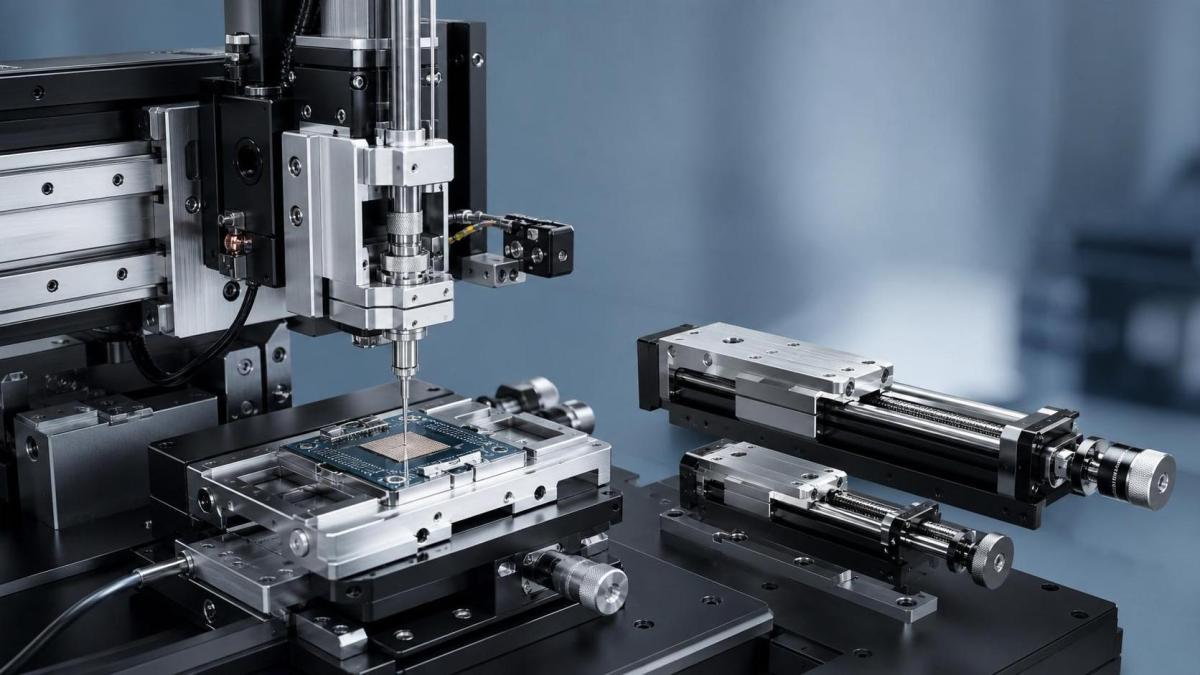
In ultra-precision systems, Micro-Manipulation stroke is never just a distance value. It defines how far a stage, actuator, or positioning head can move while holding usable accuracy.
That sounds simple, but the engineering consequence is not. As stroke increases, control bandwidth, stiffness, thermal behavior, and feedback strategy usually change together.
This is why Micro-Manipulation stroke matters in semiconductor alignment, biomedical handling, optical assembly, and aerospace micro-positioning. It directly shapes precision control quality under real operating loads.
For technical comparison work, the key question is practical: how much stroke is needed before precision, repeatability, or integration risk starts to decline in a meaningful way?
Why Micro-Manipulation Stroke Changes Control Behavior
Every precision axis balances travel range against dynamic stability. A short-travel mechanism can often stay stiffer, lighter, and easier to control than a long-travel platform.
When Micro-Manipulation stroke becomes larger, the structure may need longer flexures, rails, guides, or piezo-amplified linkages. Each addition introduces compliance, mass, and potential vibration modes.
That directly affects servo tuning. A controller that performs well over a 100 micrometer stroke may not hold the same loop stability over several millimeters.
More importantly, stroke changes the error map. Straightness error, Abbe offset sensitivity, cross-axis coupling, and thermal drift often become more visible as travel expands.
In practical terms, Micro-Manipulation stroke influences five control variables at once:
- positioning resolution across the full travel
- repeatability at different points in the stroke
- settling time after command changes
- load sensitivity and off-center moment response
- controller robustness under environmental drift
That also explains why stroke should never be reviewed as a standalone catalog number. It must be read together with bandwidth, encoder architecture, stiffness, and payload condition.
The Main Tradeoff: Range Versus Precision
A longer Micro-Manipulation stroke usually improves reach and flexibility. It can reduce repositioning steps, simplify tooling access, and support larger inspection or assembly windows.
But the same longer stroke can lower mechanical stiffness. Once stiffness drops, the axis becomes more sensitive to vibration, external disturbance, and internal resonance.
That tradeoff becomes sharper in closed-loop control. The servo must work harder to reject disturbance while avoiding overshoot, hunting, or longer settling behavior.
From a standards and benchmarking perspective, this is where specification reading often becomes misleading. Some suppliers state impressive minimum step size, but only under unloaded or partial-stroke conditions.
A more reliable evaluation reviews full-stroke performance under realistic payload, duty cycle, and ambient variation. That gives a truer picture of precision control risk.
How Stroke Length Impacts Key Precision Metrics
To assess Micro-Manipulation stroke correctly, it helps to break precision control into measurable outputs. Each output reacts differently as travel length changes.
Resolution
Resolution describes the smallest commanded increment the system can detect or execute. Longer stroke does not automatically reduce nominal resolution, but it can reduce usable resolution.
Noise, guide friction, structural deflection, and encoder interpolation limits can make tiny commands less meaningful across the full Micro-Manipulation stroke.
Repeatability
Repeatability is often the first metric to shift with a larger Micro-Manipulation stroke. Return-to-point error may grow because different travel regions experience different mechanical or thermal states.
This is especially relevant in systems using flexure transitions, air bearings, or piezo stacks with amplified displacement.
Settling Time
A longer Micro-Manipulation stroke can increase settling time after motion. The stage may reach the target quickly, yet still need extra milliseconds to suppress residual oscillation.
In high-throughput tools, that delay becomes a throughput issue, not just a motion-control issue.
Accuracy Across the Travel
Absolute accuracy depends on calibration quality, feedback layout, and geometric error compensation. As Micro-Manipulation stroke grows, maintaining uniform accuracy becomes harder.
That is why interferometer-based validation, error mapping, and multi-point calibration matter more on longer-travel systems.
Application-Specific Effects of Micro-Manipulation Stroke
The ideal Micro-Manipulation stroke depends heavily on the application window. There is no universal best value, because precision control targets change by industry.
Semiconductor
In wafer handling, probe alignment, and photonics packaging, short or medium Micro-Manipulation stroke is often preferred. Faster settling and tighter repeatability usually outweigh travel range.
Biomedical
Cell manipulation, micro-injection, and implant assembly may need finer force control over moderate travel. Here, Micro-Manipulation stroke must support smooth motion without excessive compliance.
Aerospace and Optics
Larger components or optical assemblies often demand longer access paths. In these cases, Micro-Manipulation stroke becomes an integration issue as much as a control issue.
The more complex the structure, the more important it is to validate full-stroke precision under real mounting orientation and thermal load.
What to Check During Technical Evaluation
When comparing platforms, Micro-Manipulation stroke should be reviewed through a verification checklist, not a brochure summary. That reduces hidden precision control risk during procurement.
- Confirm whether accuracy is specified at full stroke or a central travel region.
- Check repeatability under actual payload, cable routing, and duty cycle.
- Review encoder type, placement, and sensitivity to Abbe error.
- Request settling-time data at different stroke positions.
- Verify thermal drift over continuous operation, not just at startup.
- Look for resonance or bandwidth data with the final fixture installed.
- Check calibration traceability against ISO, SEMI, IEEE, or internal metrology standards.
This evaluation method is more useful than focusing on best-case resolution numbers. It reveals whether the claimed Micro-Manipulation stroke supports stable precision control in production conditions.
How to Balance Stroke, Risk, and Integration
The best decision is rarely the platform with the longest Micro-Manipulation stroke. It is the platform whose stroke matches the actual motion envelope with the least control penalty.
A useful rule is to avoid excess travel when tighter precision is the business priority. Extra stroke often adds cost, tuning effort, and uncertainty without improving output quality.
At the same time, undersized stroke creates its own problems. Frequent repositioning, fixture complexity, and limited process access can also reduce system precision and productivity.
So the right approach is balanced sizing. Define the true working envelope, then compare how each Micro-Manipulation stroke behaves across stiffness, feedback quality, thermal stability, and integration layout.
In the end, Micro-Manipulation stroke affects precision control because motion range changes the entire mechanical and servo environment. Better selection comes from full-stroke evidence, not isolated specifications.
For high-stakes applications, the most reliable path is clear: evaluate Micro-Manipulation stroke in the same conditions where the system will actually work, and let full-travel performance guide the final decision.
Recent Articles
 2026.09.27When does recyclable skincare packaging justify its higher unit cost?Skincarepackaging costs more only when it protects formulas, supports credible recycling claims, reduces compliance risk, and delivers measurable commercial value.
 2026.09.26How to choose a hiking backpack that fits your torso lengthHikingbackpacks fitting guide: measure your torso, adjust hip belts and straps, and choose a stable, comfortable pack for every trail adventure.
 2026.09.25Which ISO standards apply to precision-engineered medical devices?ISO standards for precision engineering medical devices: explore ISO 13485, ISO 14971, metrology, biocompatibility, sterilization, and packaging requirements.
 2026.09.24How to choose athletic clothing that stays comfortable in humid weatherAthletic clothing for humid weather: learn how to choose breathable fabrics, low-chafe fits, and quick-drying layers for more comfortable workouts.
 2026.09.23How sheet metal welding choices affect dimensional accuracySheet metal welding choices shape dimensional accuracy. Explore heat input, joint design, fixturing, and inspection strategies to reduce distortion and improve repeatability.
 2026.09.22How specification preparation prevents flow-control errors in process systemsSpecification preparation for process systems prevents flow-control errors by defining operating ranges, pressure budgets, accuracy, materials, and control requirements before equipment selection.
 2026.09.21How to assess a German mass flow controller supplier for cleanroom useIndustrial & Manufacturing equipment supplier in Germany: assess cleanroom MFC partners for gas compatibility, leak integrity, calibration traceability, and lifecycle service.
 2026.09.20How to assess aerospace component manufacturing services for tight tolerancesAerospace component manufacturing services: learn how to verify tight-tolerance capability through metrology, process control, special-process oversight, and traceability.
 2026.09.19When does polycarbonate roofing need UV protection on both sides?Polycarbonateroofing: learn when dual-sided UV protection prevents yellowing, installation errors, and reflected-light damage in demanding roof designs.
 2026.09.18When high precision coordinate measuring machines justify tighter tolerancesHigh precision coordinate measuring machines justify tighter tolerances when uncertainty, process capability, and traceability protect critical performance. Explore smarter decisions.
 2026.09.17How can retailers verify safety before buying Montessori toys wholesale?Montessoritoyswholesale safety guide: verify SKU-specific tests, labels, traceability and market compliance before ordering.
 2026.09.16How to assess surgical instruments for reliable sterilizationAssess surgical instruments for reliable sterilization with practical guidance on cleanability, material compatibility, inspection, and validated reprocessing.
 2026.09.15How material science for food ingredients improves shelf stabilityMaterial Science for food ingredients reveals how moisture control, encapsulation, oxidation management, and smart packaging extend shelf life and protect quality.
 2026.09.14What purity specification do laboratory gases need for trace analysis?Ultra-high purity gases for laboratory use: learn how to specify, verify, and control critical impurities for reliable trace analysis and lower backgrounds.
 2026.09.13How to verify a lubricants exporter’s product quality before orderingLearn how to verify a lubricants exporter before ordering—from batch CoAs and lab tests to traceability, packaging, and export compliance. Reduce equipment and shipment risks.
 2026.09.12When does export control compliance training need to be refreshed?Export control compliance training: learn when annual and event-driven refreshers are needed to manage regulatory, product, access, and supply-chain risks.
 2026.09.11What makes a diaper bag backpack comfortable for all-day outings?Discover how a diaperbagsbackpack delivers all-day comfort with padded straps, breathable support, smart storage, and balanced capacity for stress-free outings.
 2026.09.10How nano-positioning stages enable sub-nanometer manufacturing precisionSub-nanometer manufacturing demands more than fine resolution. Discover how nano-positioning stages deliver stable, accurate motion through advanced feedback, control, and error management.
 2026.09.09How to validate biological implants for biocompatibility riskBiological implants validation: learn how to assess biocompatibility risk with ISO 10993, chemical characterization, and manufacturing controls.
 2026.09.08What to verify before selecting an XYZ translation stage OEM factoryXYZ translation stage OEM factory selection guide: verify volumetric accuracy, payload stiffness, traceable testing, controls, and acceptance criteria before ordering.
 2026.09.07How to match mining equipment to different extraction conditionsMining equipment selection made practical: match machines to rock, mine geometry, ground conditions, capacity, energy, and maintenance needs for safer, more productive extraction.
 2026.09.07Global photonics alignment market analysis: what is driving demand?Global photonics alignment market analysis: discover how semiconductor packaging, optical communications, sensing, and automation are driving demand for scalable, high-yield alignment solutions.
 2026.09.05When do Ultra-Precision Engineering consulting services add value?Ultra-Precision Engineering consulting services help buyers reduce qualification risk, validate real-world performance, and control lifecycle costs before committing to complex suppliers.
 2026.09.04How to choose a nano-indentation system for reliable hardness testingLearn how to choose a nano-indentation system for hardness testing with confidence. Compare calibration, load control, drift stability, test modes, data quality, and application fit for reliable results.
 2026.09.03When does a bridge CMM outperform a portable measuring arm?CMM systems: discover when a bridge CMM delivers superior repeatability, tighter uncertainty control, and dependable inspection results over a portable measuring arm.
 2026.09.02How does industrial innovation analysis guide technology choices?Industrial Innovation analysis helps manufacturers choose technologies with confidence by evaluating performance, integration, compliance, and lifecycle risks. Discover a smarter decision framework.
 2026.09.01How precise must micro-manipulation systems be for microassembly?Micro-manipulation systems for microassembly: learn how to match precision, repeatability, feedback, and error budgets to achieve reliable, high-yield assembly.
 2026.08.31What to verify before choosing a wafer probe station exporterWafer probe station exporter selection starts with verified performance, integration, export readiness, and lifecycle support. Learn what to check before you buy.
 2026.08.30When does pulse welding improve precision in a micro-welding workstation?Micro-welding workstation pulse welding improves precision by controlling heat, reducing variation, and protecting delicate assemblies. Discover when it delivers measurable results.
 2026.08.29When does machine learning improve defect detection in CMM inspection?Machine learning improves CMM defect detection when measurement data is stable, traceable, and actionable. Learn how to spot early drift, prioritize risk, and strengthen quality decisions.
 2026.08.28How to compare nano-fabrication tools in North America for probe-station workCompare nano-fabrication tools North America labs use for probe-station work—evaluate motion, optics, touchdown control, thermal stability, and service support.
 2026.08.27When does biomass energy make financial sense for industrial heat?Biomass energy can cut industrial heat costs when demand, fuel supply, logistics, and compliance align. Explore the key financial tests for a resilient investment.
 2026.08.26What to check before choosing an OEM PZT driver manufacturerPZT driver manufacturer OEM selection starts with application fit. Learn what to check on stability, load matching, compliance, and lifecycle support before you buy.
 2026.08.25What a battery management system must monitor to prevent cell failureBattery management system essentials: learn what to monitor at cell level—voltage, current, temperature, SOC, balancing, and deviation trends—to prevent cell failure and improve battery safety.















FILTER_CORE
REF_NO: 0042
Editors' Picks
- 00
0000-00
When does recyclable skincare packaging justify its higher unit cost? - 00
0000-00
How to choose a hiking backpack that fits your torso length - 00
0000-00
Which ISO standards apply to precision-engineered medical devices? - 00
0000-00
How to choose athletic clothing that stays comfortable in humid weather